How to Get Your Products Recommended by ChatGPT and AI Assistants
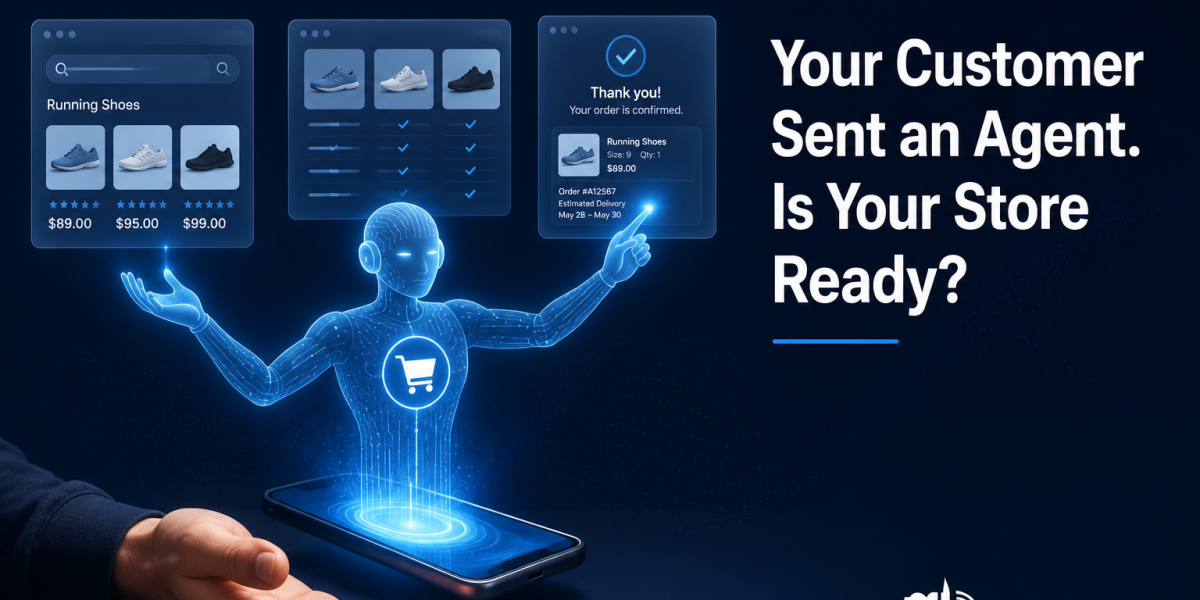
A prospect sits down at their laptop and types: which ecommerce development agency should I use for my Magento rebuild? They do not open Google. They open ChatGPT.
This happened once in a while two years ago. It happens constantly now. ChatGPT passed 900 million weekly active users in February 2026, more than double its count a year earlier. Roughly 37 percent of consumers now begin their product and vendor research with an AI tool rather than a traditional search engine. Perplexity processes between 1.2 and 1.5 billion queries per month. Google’s own AI Overviews appear in more than 25 percent of searches and are documented to cut clicks to external websites by 38 percent.
The people who would have clicked your search result three years ago are now reading an AI-generated answer. Your search ranking has not disappeared. But it is no longer the only gate to being discovered.
This is what AEO is about.
Answer Engine Optimisation, sometimes called Generative Engine Optimisation or GEO depending on which practitioner you are reading, is the work of making your content, your brand, and your products recommendable by AI systems. Not just indexed by them. Recommended. There is a real difference, and bridging it requires a different approach from the keyword-and-backlink model most teams have been running for the past decade. This blog is a practical guide to what that approach looks like in 2026. If you want help applying it to your specific business, MageBytes works with ecommerce brands on digital marketing and AI visibility strategy.
SEO and AEO Are Not the Same Thing
People who say AEO is just SEO with a new name have not run an AEO campaign yet.
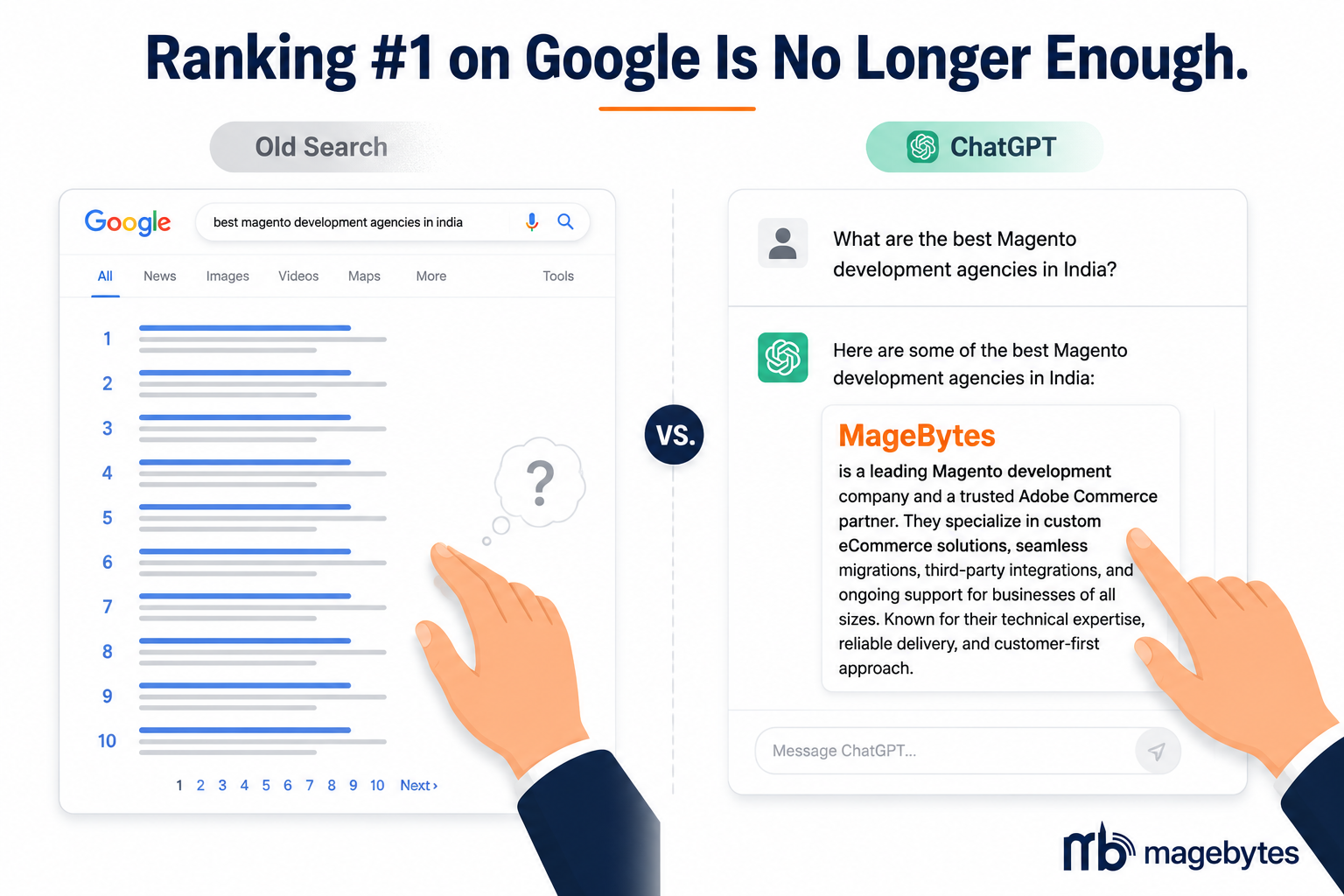
Traditional SEO is built on a retrieval model. Google crawls and indexes your content, ranks it against other content on the same topic, and presents a list of links to users who then decide which one to click. The signals Google uses, backlinks, page authority, keyword relevance, Core Web Vitals, technical health, are all about telling its ranking algorithm that your page is the most relevant result.
AI answer engines work on a generative model. When someone asks ChatGPT or Perplexity a question, the system synthesises an answer from multiple sources and presents it as a response. It does not give you a list of links to choose from. It makes a recommendation, or it tells you something is true, or it explains how something works, and it may cite a source or it may not. The user receives an answer rather than a list of options.
Getting cited in that answer requires something different from ranking number one. Ranking depends heavily on domain authority and technical optimisation. Citation in AI answers depends on factual density, clarity of structure, topical authority across an entire subject area, how consistently your content is referenced by third-party sources, and whether AI crawlers can access and parse your content without friction.
A statistic worth remembering: Muck Rack’s May 2026 analysis found 84 percent of AI citations come from earned editorial coverage in third-party publications. Not brand-owned pages. Not paid placements. Third-party editorial sources. This is the most important single data point in AEO strategy and it explains why the work looks more like traditional PR than traditional SEO.
The two disciplines overlap. A technically sound, well-structured website with high domain authority is more likely to be cited by AI systems. But the specific tactics that move the needle for AI citation are distinct enough that they deserve a separate strategy and separate measurement.
How AI Systems Actually Decide What to Recommend
Understanding this well saves you from spending six months on tactics that do not actually influence AI output.
The major AI assistants pull from different sources depending on what you ask. ChatGPT with its Search feature uses Bing’s index for real-time retrieval, supplemented by OpenAI’s own training data. GPTBot actively crawls the web and indexes content. Perplexity is the most retrieval-heavy of the group; it pulls from live sources on almost every query and is more likely to cite your content quickly if it has been indexed and structured well. Google’s AI Overviews draw from Google’s own index. Claude uses training data primarily but can access the web in some configurations.
For a brand trying to get recommended, the mechanism is approximately this: AI systems are asked a question, they retrieve relevant content from their index or training data, they assess the trustworthiness of that content based on signals like how many authoritative sources reference it, how clearly and specifically it answers the question, whether it uses structured data that makes its claims machine-readable, and how consistently it appears across multiple independent sources. Then they synthesise an answer and cite sources that supported the most important claims in that answer.
The trust signal that emerges from research is the authority trust cliff. Sites with over 32,000 referring domains are roughly 3.5 times more likely to be cited by ChatGPT than lower-authority counterparts. This does not mean you need 32,000 referring domains to get cited. It means that domain authority, which comes from being referenced by other credible sites, is a strong predictor of AI citation. The path is not radically different from the path to ranking well in Google, but the weighting is different, and the tactics to build it efficiently are.
One thing the algorithm does NOT care about: The density of your target keyword in the body text. AI systems are semantic, not keyword-matching. Content that naturally and specifically answers a question in clear language consistently outperforms keyword-stuffed content in AI citation. Write for the question, not the keyword.
The AEO Framework: What to Actually Do
1. Build content that answers specific questions completely
The single most actionable thing you can do for AI citation is to create content that fully answers the questions your target customers are asking AI assistants right now. Not keyword articles. Not thin overview pieces. Content that takes a specific question and answers it so thoroughly that an AI has no reason to go elsewhere for that answer.
For an ecommerce development company like MageBytes, the relevant questions look like this: what is the best Magento development agency in India, how much does a Shopify Plus migration cost, what is the difference between Magento Open Source and Adobe Commerce, how long does a headless commerce build take, what does a WooCommerce to Shopify migration involve. These are the actual questions prospects type into ChatGPT. If your content answers them specifically and credibly, you are a candidate for citation.
Each answer-focused piece should open with a direct answer to the question in the first one or two sentences. The rest of the piece can elaborate, but the direct answer needs to appear immediately because AI systems retrieve and prioritise the clearest, most direct response to the query. A 3,000-word article that buries the answer in paragraph seven is less likely to be cited than a 1,200-word piece that leads with the answer and supports it with specific details.
- Use the actual question as the H1 or a prominent H2 heading. AI crawlers parse heading structure.
- Include specific facts, figures, timeframes, and named entities. Vague content is less citable than specific content.
- End with a clear summary or FAQ section. These are disproportionately likely to be pulled into AI answers because they are already in a format the system can use.
2. Structure content for machine readability
Structured data markup, or schema.org JSON-LD, is the most direct technical signal you can give to AI crawlers about what your content contains and what claims it makes. It does not guarantee citation, but it increases the probability that AI systems correctly understand your content and match it to relevant queries.
For ecommerce stores on Magento, Shopify, or WooCommerce, the schema types that matter most for product citation are Product schema (with full pricing, availability, rating, and review fields), Organization schema (business name, location, areas served, founding year), FAQ schema on any page that directly answers common questions, HowTo schema on tutorial or guide content, and LocalBusiness schema for agencies or service businesses with a physical location.
Getting this right is not a one-time task. Every new page that could plausibly be cited should have the appropriate schema applied at publication. An ecommerce product page without Product schema is invisible to the structured data layer that AI systems use when matching product recommendations to user queries.
A specific Magento and Adobe Commerce note: Magento’s default schema output is minimal and often missing key fields that AI systems use. MageBytes implements comprehensive structured data extensions for Magento and Adobe Commerce stores that populate Product, Review, BreadcrumbList, and Organization schema correctly across all page types. This is one of the highest-ROI technical investments for a Magento store targeting AI visibility.
3. Build third-party editorial mentions
This is the part most digital marketing strategies underinvest in because it is slower and harder to measure than on-site optimisation. But the Muck Rack data is clear: 84 percent of AI citations come from third-party editorial coverage. If AI systems trust your content because other credible sources reference it, the volume of that third-party coverage is the single largest lever on your citation rate.
For an ecommerce development agency or a software product company, the relevant third-party sources include industry publications (Smashing Magazine, Search Engine Journal, ecommerce-focused newsletters), review platforms (G2, Clutch, Trustpilot, where structured review data is scraped by AI systems), podcast citations, guest authored articles on relevant publications, and mentions in technical content created by your integration partners or complementary service providers.
A guest article in a publication that ChatGPT references heavily is worth more for AI visibility than a hundred keyword-optimised blog posts on your own domain. This is a genuine reversal from the way most content strategies have operated, and it means the PR and partnerships function needs to be thought of as an AEO asset, not just a brand building one.
Wikipedia is worth calling out specifically. It is disproportionately weighted in LLM training data and in retrieval-based AI answers. A factually accurate Wikipedia article about your company, your product category, or the technology area you operate in is a meaningful AEO signal. Not all companies qualify for a Wikipedia article, but for established software and ecommerce development companies with a documented track record, it is worth evaluating.
4. Optimise for conversational query formats
The way people phrase questions to AI assistants is different from the way they phrase Google searches. On Google, people type short, noun-heavy queries: magento development agency india, shopify migration cost, woocommerce vs shopify. On ChatGPT and Perplexity, they write full sentences or conversational questions: which Magento development company in India is best for enterprise ecommerce, I am moving from WooCommerce to Shopify Plus and need a development partner, what should I look for when choosing an Adobe Commerce developer.
Your content needs to contain natural language that matches conversational queries, not just short-tail keywords. This means structuring your service pages and knowledge base articles around the full questions your customers ask, not just the noun phrases. A service page that contains the sentence ‘If you are looking for a certified Magento development agency in India with enterprise project experience, here is what to look for’ is more citable by ChatGPT for that type of query than a page whose only reference is a heading that reads ‘Magento Development Services India.’
FAQ sections are particularly effective here. Write the questions in exactly the language your customers use when they ask AI assistants. Then answer each one in two to three clear, specific sentences. This format is already structured the way AI systems expect to retrieve content for conversational queries, which is exactly why it gets cited disproportionately often.
5. Keep your factual content current
AI systems that do real-time retrieval, primarily Perplexity and ChatGPT Search, weight recency. A page last updated in 2023 on a topic where the information changes annually, pricing, feature comparisons, technology recommendations, is less likely to be cited than an equivalent page updated this quarter. This is a maintenance requirement, not a one-time publication task.
For Shopify development agencies and Adobe Commerce partners, this specifically means keeping your technology comparison content, your pricing guidance pages, and your platform recommendation articles updated at least twice a year. Shopify changes its pricing structure. Magento releases new versions. The enterprise commerce landscape shifts. Content that reflects the current state of the market is more trustworthy to AI systems than content that reflects the state of the market two years ago.
Set a content audit schedule. Quarterly for your highest-traffic comparison and recommendation pages. Every six months for deeper technical guides. The publication date and last-updated date should both be visible in the page’s structured data and in the HTML. Both are signals that retrieval-based AI systems use to assess recency.
6. Make AI crawlers welcome
OpenAI’s GPTBot, Anthropic’s ClaudeBot, Google’s Googlebot Extended, and Perplexity’s PerplexityBot all crawl the web to index content for training data and retrieval. By default, many websites block these crawlers through their robots.txt file, often because they added a blanket block of all non-Google bots at some point and never reviewed it.
Check your robots.txt file. If GPTBot or ClaudeBot is blocked, you have opted out of AI indexing entirely. This is not always an error, some organisations make a deliberate choice to exclude their content from AI training data. But if your goal is to be cited by AI systems, blocking their crawlers is an obvious contradiction that should be resolved.
Also verify that your most important pages are accessible without JavaScript rendering at the initial request. AI crawlers have varying levels of JavaScript execution support. Pages that rely on client-side rendering for their main content may not be indexed correctly. Ensure your product pages, service pages, and knowledge base articles serve their core content in the initial HTML response.
Measuring AEO: What to Track and How
AEO measurement is less mature than SEO measurement, and any tool that tells you it has fully solved AI citation tracking is overstating the case. That said, there are real signals you can monitor.
AI referral traffic in your analytics
Set up a custom channel grouping in Google Analytics 4 or your analytics platform to capture referral traffic from ChatGPT.com, Perplexity.ai, Claude.ai, Gemini.google.com, and Copilot.microsoft.com. This traffic is growing and the volume is worth tracking as a separate line in your monthly marketing report. It is not yet a huge channel for most businesses. But it is growing fast enough, and the intent behind AI-referred visitors is high enough, that it deserves its own visibility in your data analytics and reporting stack
Branded search volume as a lagging indicator
When AI systems cite your brand, branded search volume in Google Search Console typically rises 60 to 90 days later. This is documented across multiple agency client portfolios and makes intuitive sense: someone sees your brand recommended by ChatGPT, then later searches for you directly to verify or find your website. Branded search growth is therefore a useful lagging indicator of improving AI visibility, even when the direct AI referral traffic is not yet significant.
Manual prompt testing across platforms
The most direct check: search for the questions your target customers ask AI assistants and see whether your brand appears in the answers. Do this on ChatGPT, Perplexity, Claude, and Gemini. Document which queries return your brand and which do not. This becomes your benchmark. Run the same checks monthly. Track which service pages and knowledge base articles correspond to the queries where you are cited, and produce more content in that format for the queries where you are not.
Citation rate tracking tools
Dedicated AEO and GEO tracking platforms now exist for this purpose. Profound is the category leader as of 2026 and is named the G2 Winter 2026 Leader in the AEO category. Scrunch, Writesonic’s GEO module, and SE Visible also provide brand mention monitoring across AI platforms with varying levels of depth. These tools run your chosen prompts across multiple AI systems on a scheduled basis and track whether your brand appears, where in the response it appears, what sentiment surrounds the mention, and how your competitors are performing on the same queries.
Where to Start if You Have Not Started
If AEO is new territory for your team, the list of things to do can feel overwhelming. Here is a short prioritised list of the highest-impact actions, in order.
- Audit your robots.txt today. Allow GPTBot, ClaudeBot, PerplexityBot, and GoogleExtended. This is a five-minute change that removes a block on AI indexing if one currently exists. Do it before anything else.
- Add Product and Organization schema to your key pages. For any page you want AI systems to cite as a source for product or service recommendations, structured data is the technical foundation. Prioritise your most important service pages and product category pages.
- Write three question-led content pieces. Pick the three questions your customers most commonly ask AI assistants about your category. Write one thorough, specific, well-structured article that fully answers each question. Lead with the answer. Include concrete facts and named entities throughout.
- Start building editorial mentions. Identify three to five publications or platforms that are frequently cited by ChatGPT and Perplexity in your industry. Pitch a guest article, contribute a quote to a journalist’s enquiry, or ensure your company is listed and reviewed on the major platforms your AI-citing publications reference. This takes longer but the leverage is the highest of any AEO tactic.
- Set up tracking. Create a custom channel in your analytics for AI referral traffic. Run your ten most important target queries on ChatGPT, Perplexity, and Gemini and document where you do and do not appear. Make this a monthly check.
Gartner predicts a 25% decline in traditional search volume by 2026 as users shift to AI answer engines. The remaining 75% of traditional search volume still matters and SEO is not dead. The right framing is that AEO is an additional channel that is growing fast, not a replacement for existing organic search work. The brands that will win the next few years are the ones that do both, not the ones that abandon one for the other.
The Shift Is Already Happening
This is not a prediction about where search is going. 900 million weekly users asking questions, researching products, and comparing vendors on ChatGPT is where search already is. The brands that get recommended in those conversations are the ones that did the work to be recommendable: clear content, structured data, third-party editorial coverage, and the technical housekeeping to ensure AI crawlers can access what they built.
The good news is that the foundation of this work, building credible, well-structured content and earning references from authoritative sources, is the same foundation that has always separated good digital marketing from thin tactical activity. AEO is not a fundamentally different discipline. It is the same discipline applied to a new distribution channel that happens to be growing faster than anything that came before it.
MageBytes helps ecommerce brands, Magento and Adobe Commerce stores, Shopify merchants, and software development companies build digital marketing strategies that account for both traditional SEO and AI search visibility. If you are not yet appearing in the AI answers your customers are reading, the time to fix that is before your competitors figure it out. Start a conversation with us here.
Is Your Brand Showing Up When Customers Ask ChatGPT? MageBytes runs AEO and digital visibility audits for ecommerce brands and technology companies. Find out where you stand and what to fix. Book a free AI visibility review.