What AI Shopping Agents Mean for Your Store’s Checkout
For about fifteen years, ecommerce has operated on roughly the same assumption: a human sits on one side of the screen, browses a catalogue, reads some product descriptions, maybe checks a few reviews, and then clicks through to checkout. The store’s job is to make that browsing experience pleasant enough that the person reaches the end.
That assumption is cracking.
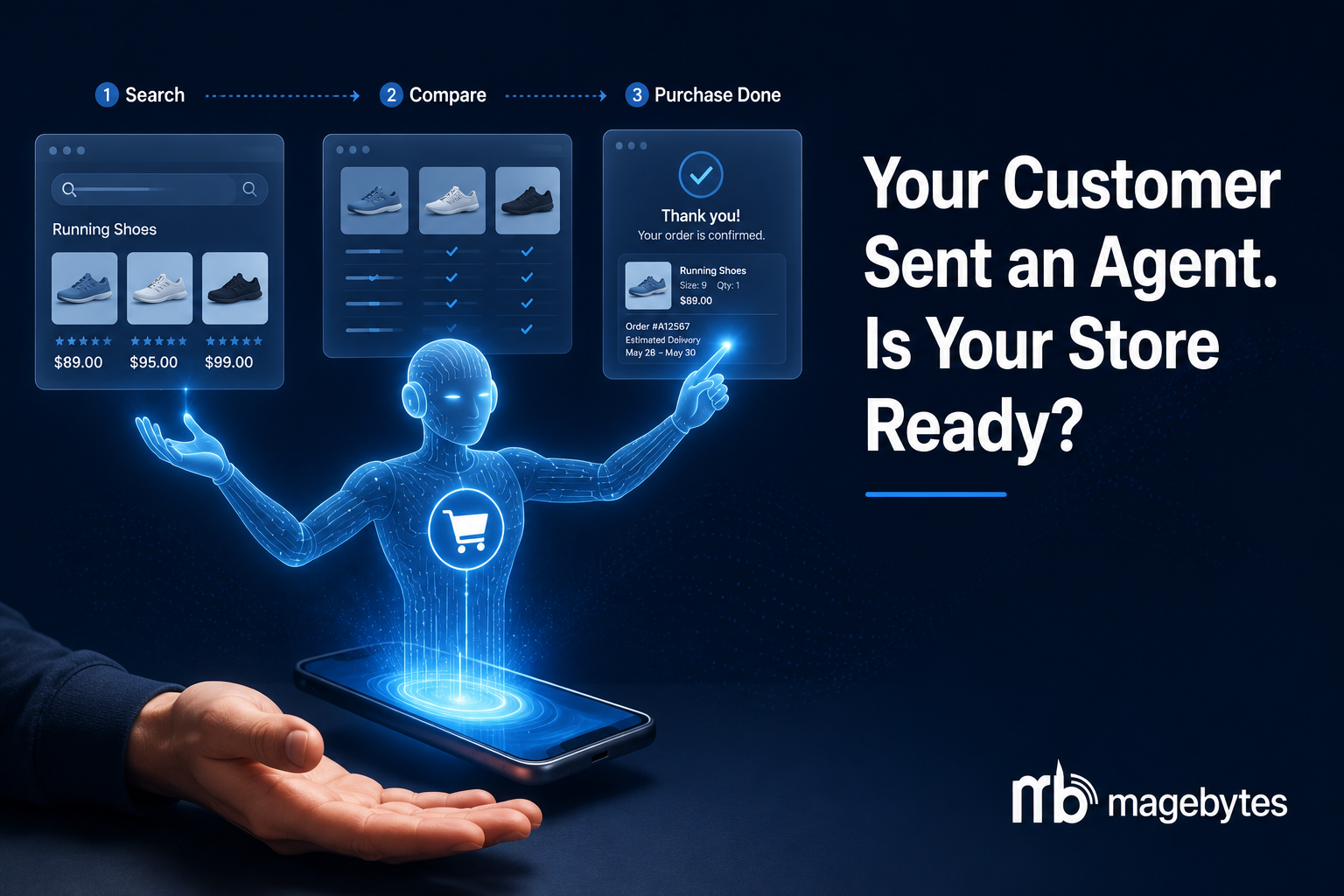
Not dramatically, not all at once. But in 2026 there are already buyers who do not touch your checkout themselves. They set a goal, give it to an AI agent, and the agent handles the rest: research, comparison, selection, and in some cases, payment. The person gets a notification that the task is done. Your store either participated in that transaction or it did not, and the buyer never saw the difference because they were not watching.
This is agentic commerce. The word is everywhere in retail and technology right now but the substance behind it is real and specific, and it has concrete implications for how ecommerce stores are built, how product data is structured, and how checkout flows are designed. This piece is a practical explanation of what is actually happening, where it stands right now in mid-2026, and what store owners and ecommerce teams need to do about it.
If you are building or running an ecommerce store on Magento, Shopify, WooCommerce, or BigCommerce and this feels like something you should have started preparing for six months ago, that is a reasonable instinct. Here is where to start.
What an AI Shopping Agent Actually Does
The phrase AI shopping agent gets used loosely, so it is worth being precise about what distinguishes an agent from a chatbot or a recommendation engine.
A chatbot responds to questions. An agent takes actions. When you ask a chatbot which laptop to buy, it tells you. When you give the same question to an agent with purchasing capability, it looks at your preferences and budget, queries multiple retail sources in real time, evaluates the options programmatically, selects the one that best fits the defined criteria, and initiates the purchase. You told it what you wanted. It handled the rest.
Agents operate on structured intent. They parse a user’s goal, extract the constraints embedded in it, budget, delivery window, brand preference, technical specifications, and translate those constraints into API calls against product catalogues, pricing services, inventory feeds, and shipping estimators. The evaluation happens at the data layer, not the visual layer. The agent is not reading your product page the way a customer does. It is querying your product API the way a developer does.
This is what most ecommerce store owners have not fully absorbed yet. The traditional checkout experience, the homepage, the category navigation, the product photography, the persuasive copy, the optimised add-to-cart button, these are designed for a human processing visual information and making an emotional decision. An AI agent processes none of that. It reads structured data and makes a programmatic decision based on whether your product meets the specified parameters.
In agentic commerce, your store’s visibility is determined by data quality and API accessibility, not design quality. A beautiful storefront with incomplete product metadata is invisible to an agent. A plain storefront with complete, accurate, machine-readable product data is selectable.
Where Things Actually Stand in Mid-2026
The coverage of agentic commerce tends to oscillate between two extremes. Either it is years away and not worth worrying about yet, or it has already arrived and everything is fundamentally different. Neither is quite accurate.
Here is the honest picture. Google launched agentic checkout functionality in January 2026, with a Buy for Me button live at selected US retailers through Google’s AI Mode and Gemini. The Universal Commerce Protocol launched at NRF in January 2026 as an open standard enabling AI agents to interact with merchant catalogues and execute purchases through a shared protocol. Microsoft Copilot Checkout went live in the US at the same time.
Shopify reported that orders arriving from AI-powered searches grew 15 times year-over-year through 2025. OpenAI introduced shopping research in ChatGPT using GPT-5 mini, with reinforcement learning for comparative product guides and real-time evaluation across retail sites. ChatGPT’s Agentic Commerce Protocol handles product discovery and merchant redirect: the agent identifies the product, the buyer completes the transaction on the merchant’s own site rather than inside ChatGPT.
That last point is worth noting. OpenAI deprecated Instant Checkout in March 2026. The current ACP model stops short of fully autonomous purchase completion inside the chat interface. Agents research and recommend. Buyers confirm and pay on the merchant’s site. The agent handles the hard part of the journey, discovery and comparison, but the final confirmation stays with the human for now.
Morgan Stanley projects that nearly half of online shoppers will use AI shopping agents by 2030, accounting for roughly 25 percent of their spending. The dollar figure attached to the overall market impact is around $385 billion by 2030 per Morgan Stanley’s own modelling. These are projections, not certainties. But the directional trend, AI mediation of the discovery and evaluation phase of purchase, is already visible in the 2025 to 2026 data and is not reversing.
The practical status in mid-2026: Agentic commerce is live but partial. The discovery and comparison phase is already being handled by AI agents for a growing slice of shoppers. The fully autonomous purchase completion phase is early and limited to specific platforms and retail partnerships. Stores that prepare now are ahead of the curve. Stores that wait for it to become mainstream before acting will spend 2027 catching up.
What This Means for Your Checkout Specifically
Every conversation about agentic commerce focuses on product discovery and AI recommendation. Not enough attention goes to what happens at the checkout layer, which is where most ecommerce stores have the most technical debt to address.
The checkout flow was built for humans
Your checkout process was designed around a human user. Multi-step forms. CAPTCHA verification. Browser-based session management. Pop-ups asking if the user wants to save their address. Payment flows that open a new window or redirect to a gateway. These are all features that work for a person clicking through a browser and they are all obstacles for an AI agent trying to complete a transaction programmatically.
An agent navigating a traditional checkout faces several structural problems. CAPTCHA blocks non-human requests by design. Session-based authentication assumes a browser with cookies and persistent state. Multi-page checkout flows require sequential form submissions that an agent has to navigate step by step, often encountering validation logic and error states not documented in any API. Payment flows that redirect to third-party gateways add another authentication step that breaks the agent’s execution path. For Magento and Adobe Commerce stores in particular, the checkout architecture was built for browser-based sessions and requires deliberate API-first extension to handle agent-initiated transactions.
The API-first checkout is not optional anymore
If your store’s checkout is only accessible through the browser interface, AI agents cannot complete purchases on it. The stores that participate in agentic commerce are the ones that expose their checkout flow through a properly documented API: add to cart, apply shipping options, handle payment tokens, and confirm orders, all available as API calls with structured responses.
Shopify has a head start here. The Storefront API and the Cart API expose checkout as API-accessible operations, which is why Shopify is disproportionately represented in early agentic commerce integrations. Magento’s REST and GraphQL APIs cover cart and checkout operations but many stores have not fully configured or documented those endpoints. BigCommerce’s headless API is similarly capable but requires deliberate setup. WooCommerce’s REST API covers cart and order operations but older configurations may not expose all the endpoints an agent needs.
Payment tokenisation and agent identity
For an agent to complete a purchase on behalf of a user, two things need to work correctly. The payment credentials need to be stored in a tokenised form that the agent can pass without the user manually entering card details at the moment of purchase. And the agent needs to authenticate as an authorised representative of the user in a way that your store’s fraud detection does not flag as suspicious activity.
Both of these are active areas of development in the commerce protocols that Google, OpenAI, and the payment networks are building out. Apple Pay and Stripe’s payment request infrastructure already support the tokenisation layer. The agent identity and authorisation standards are less mature. The practical implication for store owners right now is to ensure your payment gateway integration supports modern tokenisation standards and that your fraud scoring does not block API-initiated requests from legitimate platforms.
One specific thing to check now: if your store uses CAPTCHA at checkout or has fraud rules that flag non-browser user agents, those settings may need to be adjusted as agent traffic grows. An agent completing a legitimate purchase on behalf of a verified customer should not be blocked by a CAPTCHA. Work with your payment provider on allowlisting recognised agent platforms as they emerge.
Product Data: The Real Competitive Advantage
In traditional ecommerce, the product description existed to persuade a human. The photography existed to show a human what they were buying. The specifications existed to answer the questions a human would have before committing. All of this was calibrated for human decision-making.
An AI agent reads none of that the same way. It parses structured fields: name, SKU, price, inventory status, weight, dimensions, material, compatibility, return policy, shipping options, and ratings score from a verified source. If those fields are complete, accurate, and machine-readable, the agent can evaluate the product. If they are missing, inconsistent, or only present in unstructured body text on a product description page, the agent skips it. Not because of a deliberate decision. Just because the data it needs to make the evaluation is not there in a form it can use.
Walmart’s Sparky agent and eBay’s agentic AI systems, both announced in 2025, made this explicit in their documentation: AI agents prioritise structured, complete, consistent product data over creative or persuasive product presentation. The implication for store operators is direct. Every missing specification on your product page, every inconsistently formatted category attribute, every product without a return policy specified in a structured field, is a reduction in your visibility to agents evaluating that product category.
For Adobe Commerce and Magento stores with large catalogues, this is often the biggest immediate task. Magento’s EAV attribute system means that adding structured attributes to all products in a category is straightforward once the attributes are defined. The problem is usually that the attributes exist but a significant proportion of the catalogue does not have them populated. An audit of attribute completeness across your product catalogue is, right now, one of the highest-value things you can do to prepare for agentic commerce.
What complete product data looks like for agent readability
- All specification attributes populated, not just the primary ones visible on the product page
- Price displayed with currency code and whether it includes tax, not just a number
- Stock status and quantity as real-time fields, not cached values updated overnight
- Return policy linked to a structured data field, not buried in a terms and conditions page
- Shipping options and estimated delivery windows accessible via the catalogue API, not calculated only at checkout
- Review score from a verifiable source, not a manually entered number
- All product variants linked to their parent with complete individual attribute sets, not inherited from parent defaults where the variant has different specifications
The Customer Relationship Question
One concern that comes up every time agentic commerce is discussed with store operators: if an AI agent handles discovery, comparison, and purchase, what happens to the customer relationship?
It is worth being clear about the current model. Under OpenAI’s Agentic Commerce Protocol, as it stands in mid-2026, the agent does the research and makes a recommendation but the buyer is redirected to the merchant’s own site to complete the transaction. The customer relationship, the login, the loyalty programme, the post-purchase email sequence, the account history, all of this still happens between the customer and the merchant directly. The agent is an intermediary for discovery, not a barrier to the brand relationship.
That may evolve. Fully autonomous purchase completion, where the agent handles payment and confirmation entirely without the buyer touching the merchant’s interface, is technically possible and is being tested in controlled environments. When that model becomes mainstream, the relationship question gets more complex. But it is not the current situation, and responding to the current situation is more useful than planning for a hypothetical one.
What stores can do now to protect the customer relationship in an agent-mediated world: ensure your post-purchase flow, the confirmation email, the shipping notifications, the account creation prompt, is triggered correctly by API-initiated orders, not just browser-session orders. Many Magento implementations have post-purchase automations tied to browser session events that do not fire for API orders. Audit that now rather than finding out after agent-initiated orders start arriving that customers are not receiving their order confirmations.
Stores that invest in loyalty infrastructure, customer accounts with purchase history, personalised reorder capabilities, clear communication preferences, are better positioned for agentic commerce than stores relying purely on acquisition. An agent asked to reorder a previous purchase from a known merchant will look for a stored account with purchase history before searching the broader market. The customer relationship is a competitive moat.
The B2B Angle That Gets Overlooked
Most agentic commerce coverage focuses on consumer retail. The B2B opportunity is arguably more significant, and further along in actual deployment.
In B2B purchasing, the use case for AI agents is immediate and obvious. A procurement manager who needs to reorder 500 units of a component from the same supplier they have used for three years does not need to browse a product page. They need an agent that checks current pricing, confirms availability, verifies the delivery timeline against their production schedule, and submits the purchase order through the supplier’s API. That agent pays for itself in the first month in time saved.
The B2B stores and platforms that are furthest ahead on agentic readiness are the ones that already have a properly implemented B2B API, ideally an API that supports account-based pricing, order history access, and purchase order creation programmatically. BigCommerce has native B2B portal capabilities that expose B2B-specific pricing and ordering through its API. Magento B2B covers account-level pricing, requisition lists, and purchase approval workflows through its GraphQL layer. For B2B sellers on either platform, ensuring these APIs are fully configured and documented is the most direct preparation for the wave of agent-initiated B2B purchasing that the next two to three years will bring.
The negotiation dimension is also worth noting. Some B2B agentic commerce implementations in 2025 and 2026 have gone beyond static pricing to include programmatic negotiation: an agent queries a supplier’s API, receives a price, applies rules about what the buyer is willing to pay, and sends a counter-offer through a structured negotiation protocol. This is niche right now. In three years it will not be.
The Honest Summary
Agentic commerce is real, it is already live at significant scale in the discovery phase, and the checkout readiness work that stores need to do is specific and actionable. None of it requires waiting to see how this plays out.
Complete your product data. Not the fields that look good on the product page; the fields that allow a programmatic system to make an evaluation. Expose your checkout as an API. Check your fraud rules and CAPTCHA configurations for agent compatibility. Audit your post-purchase automations for API-initiated orders. Build the customer account and loyalty infrastructure that gives agents a reason to return to your store for repeat purchases rather than going back to the open market.
That is the checklist. It is not overwhelming.
What is less useful is treating this as a distant future concern that can be addressed when it becomes mainstream. The stores that are easy for agents to work with will get agent-initiated traffic when agents become mainstream. The stores that are not will spend 2027 rebuilding their checkout and product data layer under competitive pressure. Doing that work now, when there is no urgency and no fire to put out, is considerably cheaper.
MageBytes builds ecommerce stores on Magento, Shopify, WooCommerce, and BigCommerce with the API layer and data architecture that agentic commerce requires. We also audit existing stores against agent-readiness criteria and prioritise the fixes that will matter most as agent traffic grows. If you want to know where your store actually stands against this checklist, we are easy to reach.
Is Your Store Ready for AI Shopping Agents? MageBytes audits ecommerce stores for agentic commerce readiness: product data, API coverage, checkout architecture, and post-purchase flows. Book a free readiness review.