Stop Writing Product Descriptions Manually. Here Is a Better Way
Ask any Magento store owner what their content team spends the most time on and the answer is usually the same thing: product descriptions. Not the design work, not the development, not even the promotional campaigns. The product descriptions.
A catalogue of 2,000 products means 2,000 individual descriptions to write, edit, optimise for search, and keep current as products change. For a team of three managing both the store and the marketing, that workload does not fit into a normal week. Content gets pushed back, descriptions get copied and lightly edited, thin content accumulates quietly across hundreds of product pages, and the SEO impact compounds in the wrong direction for months before anyone notices.
This is an extremely common problem. It also has a direct solution now.
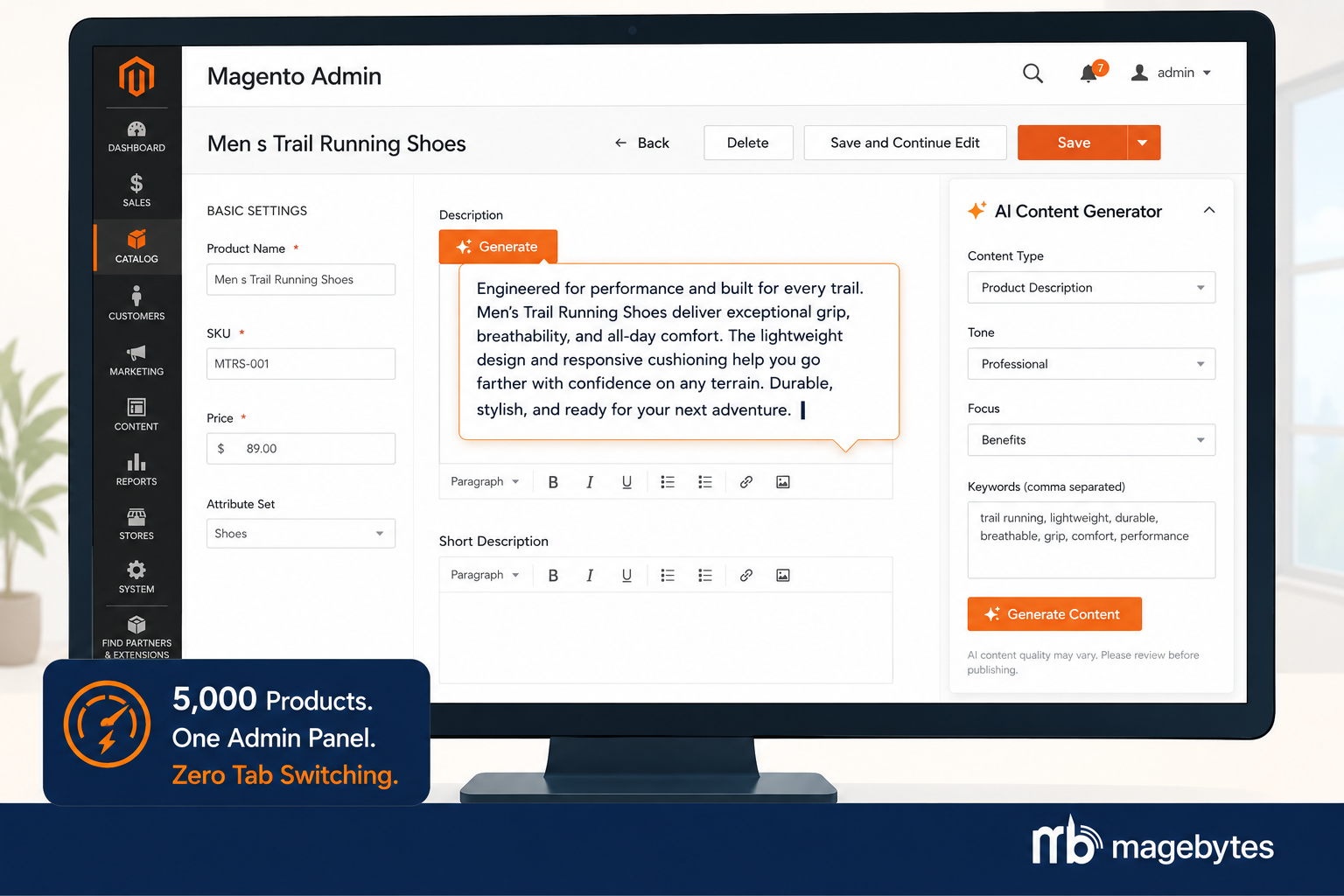
The MageBytes AI Content Generator for Magento 2 puts AI-powered writing directly inside the Magento Admin panel. Not through a separate tab, not through a third-party tool you have to open alongside Magento, not through a workflow that involves exporting to a spreadsheet and importing back. Right inside the admin. Open a product, click Generate, review the output, and publish. That is the complete workflow.
The Real Cost of Doing This Manually
The argument for manual product content is usually about quality control. The argument against is about mathematics.
A competent copywriter writing product descriptions at a decent pace produces around 20 to 30 per day, depending on research complexity. For a catalogue of 5,000 products, that is somewhere between 170 and 250 working days of writing before you have covered the full catalogue once. And the catalogue does not stand still. New products arrive, existing products get updated, seasonal lines rotate in and out.
Most teams do not have 250 days of writing capacity sitting idle. So they prioritise. The top 200 products get real descriptions. The next 500 get shorter ones. The remaining 4,300 get placeholder text, copied descriptions from manufacturers, or nothing meaningful at all. Those 4,300 product pages with thin or duplicate content are a drag on organic search performance for the entire domain, not just for the individual pages.
The SEO consequence: Google’s quality assessment for ecommerce sites considers the overall ratio of high-quality pages to thin pages across the domain. A store where 80 percent of product pages have generic, duplicate, or near-empty descriptions signals low editorial quality across the whole site, not just on those specific pages. This is why content depth matters at the catalogue level, not just on the homepage and top category pages.
The AI Content Generator addresses this at scale. Instead of choosing which products get real descriptions and which get placeholders, a team can generate a first draft for every product in the catalogue, review the outputs that matter most, and publish across the full catalogue in a fraction of the time.
How the Extension Actually Works Inside Magento Admin
The installation follows standard Magento extension practices. There are no core file overrides, which means it is upgrade-safe and compatible with the typical Magento deployment workflow. Once installed, all configuration happens through the Magento Admin configuration panel. You connect your AI API key, configure the prompts for each content type, set token limits, and you are ready.
The user-facing workflow is deliberately simple. An administrator opens a product, category, or CMS page in the admin. The extension adds a Generate button contextually in the content area. Click it, and the extension sends your configured prompt along with the product or category data to the AI API, retrieves the response, and drops the generated text into the field for review.
Nothing goes live without you seeing it first. The generated content appears in the editable field so you can adjust, rewrite, or replace any part of it before saving. The extension does not publish automatically. It drafts. That distinction matters for teams who are rightly cautious about unreviewed content appearing on their live store.
Three content types supported
Product descriptions: The primary use case. The extension pulls product name, attributes, and any existing data to inform the prompt, then generates a description in the tone and style defined in your configuration. For a store with consistent brand voice requirements, the configurable prompt is where you encode those requirements: professional but accessible, technical but readable, focused on benefits rather than features, whatever your brand actually needs.
Category page content: Category introductions are one of the most consistently neglected content opportunities in ecommerce. They sit above the product grid, they are indexed by search engines, they are frequently empty or identical across subcategories, and they are one of the easiest things to fix with a well-configured AI prompt. A good category introduction explains what the shopper will find in this section, what differentiates the range, and uses the category’s natural search terms in a way that reads as editorial rather than keyword-stuffed.
CMS pages: Homepage sections, landing pages, about us content, informational guides. The extension supports content generation for any CMS page type in Magento, which means teams running campaign landing pages or seasonal content can draft new page copy significantly faster than writing from scratch every time.
The Features That Matter in Practice
Configurable Prompts Per Content Type
This is the feature that separates a useful AI content tool from a generic one. Different content types need different instructions. A product description prompt needs to know the tone, the word count target, whether to lead with benefits or specifications, and whether to include a call to action. A category introduction prompt is shorter, more navigational, and written for a different reading context.
The AI Content Generator lets you configure separate prompts for products, categories, and CMS pages through Magento Admin settings. Once set up, every team member using the extension gets consistent output because they are all working from the same configured instruction. You write the prompt strategy once and it scales across every content generation request your team makes.
Token Limit Control
Token limits determine the maximum length of generated content. For a short product description on a fashion item, 150 tokens might be appropriate. For a detailed technical specification on an industrial product, 400 tokens gives the AI room to cover the relevant detail. Setting token limits per content type means you are not manually trimming outputs to size after every generation.
This also has a cost implication. AI APIs charge by token. If your prompts are generating 600-token responses when 200 would suffice for the content type, you are paying for three times the output you need. Token control keeps costs predictable as you scale content generation across a large catalogue.
Secure API Key Storage
Your AI API credentials are stored within Magento’s own configuration system using the same security practices that protect your payment gateway credentials, SMTP passwords, and other sensitive admin configuration. They are not stored in a flat file, not exposed in the frontend, and not shared with any external system beyond the API call itself.
This matters particularly for
Adobe Commerce and Magento Open Source deployments in environments with security review requirements. The credential handling follows Magento’s established security model rather than introducing a new credential storage pattern.
No Core File Changes
Every extension that modifies Magento core files creates upgrade risk. When Magento releases a security patch or a minor version update, any core override has to be reviewed and potentially rewritten to maintain compatibility. The AI Content Generator is built following Magento’s module development standards with no core overrides, which means it survives standard Magento updates without manual intervention.
This is not just a technical nicety. For certified Adobe Commerce developers managing client stores, the no-core-override requirement is often non-negotiable. An extension that modifies core files fails agency code review regardless of what else it does well. This extension passes that review.
Compatible with Magento 2.4 and Adobe Commerce Cloud
The extension is tested and supported on Magento Open Source 2.4, Adobe Commerce on-premises 2.4, and Adobe Commerce Cloud (cloud infrastructure). Stability is listed as stable build on version 1.0.0, with twelve months of free updates included and a 30-day money-back guarantee.
What This Actually Does for Your Magento Store’s SEO
The SEO argument for AI content generation on Magento is not about gaming search engines. It is about fixing a structural problem that affects a significant number of product-heavy stores: thin content at scale.
A product page with a one-sentence description, a manufacturer’s copy-pasted spec sheet, or content that is identical across twenty variations of the same product is not doing SEO work. It is not being indexed with sufficient depth for Google to understand what the page is about in the context of related queries. It is not being cited in AI Overviews because there is nothing distinctive enough to cite. It is not earning clicks from search results because there is no compelling meta description to differentiate it from the twenty other results on the page.
Unique, descriptive product content fixes each of those problems. The page gives Google more signal about what the product is and who it is for. The content contains the natural language variations of the search terms people use when they are actually shopping. The meta description gets populated with something specific enough to earn a click.
Google’s John Mueller has stated repeatedly that thin content at scale is one of the factors that can suppress the visibility of an entire domain, not just the individual pages with thin content. For a store where hundreds of product pages have inadequate descriptions, improving content quality across the catalogue is a whole-domain SEO fix, not just a page-level one.
For Magento stores with large catalogues, the AI Content Generator is also relevant to the GEO and AEO opportunity. AI shopping agents and Google AI Overviews cite structured, descriptive product content when making product recommendations. A store with thorough, unique product descriptions is more visible to AI-mediated discovery than a store with thin content, regardless of how strong its other SEO signals are.
Who Should Use This Extension
Stores with catalogues above 500 products
Below 500 products, manual writing with a focused content team is manageable. Above that threshold, the time cost of maintaining unique, quality descriptions across the full catalogue without automation becomes genuinely difficult. The extension makes the most commercial sense for stores where content volume is the constraint, not content quality or creative direction.
Teams managing content without dedicated copywriters
A lot of Magento store management teams are lean. The person who manages the catalogue also handles admin, sometimes customer service, sometimes some of the marketing. Hiring a full-time copywriter for product descriptions is not always viable. The AI Content Generator reduces the content burden without reducing the quality of the output when the prompts are configured thoughtfully.
Agencies managing multiple Magento client stores
For a Magento development agency or an ecommerce management agency running multiple client stores, the extension scales the content operations for each client without scaling the headcount. The configurable prompts mean each client’s brand voice can be encoded separately, and the secure API key management means credentials are contained within each client’s admin environment.
Stores launching new product lines under time pressure
A new product range launching in two weeks with 300 new SKUs and no descriptions yet is exactly the scenario this extension was built for. Generate a first draft for all 300 products, review the ones going into the sale launch hero positions, publish the rest. The launch has content. The content gets refined over time. Nothing goes live empty.
Pricing and What You Get
The AI Content Generator for Magento 2 is priced at $99 for the Community Edition (Magento Open Source) and $149 for Enterprise and Adobe Commerce Cloud editions. Every purchase includes twelve months of free updates and direct engineer support, not a support ticket system routed through multiple teams. The extension also comes with a 30-day money-back guarantee.
The API usage cost for the AI calls themselves depends on which AI provider you connect and your usage volume. The extension supports standard AI API integration so you use your own API credentials, meaning cost is transparent and predictable based on your actual token consumption.
For a store with 2,000 products, generating a 200-token description for every product at current AI pricing from major providers typically costs between $2 and $8 in API fees for the full catalogue run. The extension itself pays for itself many times over in the first content generation session alone.
The extension works with standard AI APIs, so you are not locked into a specific AI provider. As AI pricing continues to evolve and new models become available, you can update the API configuration in Magento Admin without changing the extension itself.
A Practical Note on Getting the Best Output
AI content generation tools produce better results when the prompt is specific and the brand voice is clearly defined. A prompt that says ‘write a product description’ produces generic output. A prompt that says ‘write a 180-word product description for an outdoor gear retailer, lead with the primary use case, include the key technical specification in the second paragraph, and close with a direct sentence about durability’ produces something usable on the first pass.
The configurable prompt feature in the AI Content Generator is where you invest the most initial setup time. Write the prompts carefully, test them on a sample of products from different categories, and refine based on what the output actually looks like versus what you need. That upfront prompt work is the difference between an extension that saves hours every week and one that saves some time but still requires significant editing on every output.
If you are running Magento 2 or Adobe Commerce and content volume is a genuine operational constraint for your team, the AI Content Generator is available directly from the MageBytes store. If you have questions about installation, configuration, or whether it is the right fit for your specific catalogue and workflow, the MageBytes team is available for a direct conversation. Reach us through the contact page or browse the full MageBytes extension library for other tools built for Magento merchants.
Stop Writing Product Descriptions One by One. The MageBytes AI Content Generator puts AI-powered writing inside Magento Admin. Community Edition $99. Enterprise $149. 30-day money-back guarantee. Get the extension here.