What They Will Cost You and How to Prepare Right Now
Most businesses discovered Microsoft’s July 2026 Copilot and M365 licensing changes through an unexpected email from their IT administrator or a renewal quote that suddenly looked different from last year. The headlines were familiar enough: AI is getting baked in, pricing is going up, and there are new bundle options to evaluate. The details, however, are where things get complicated.
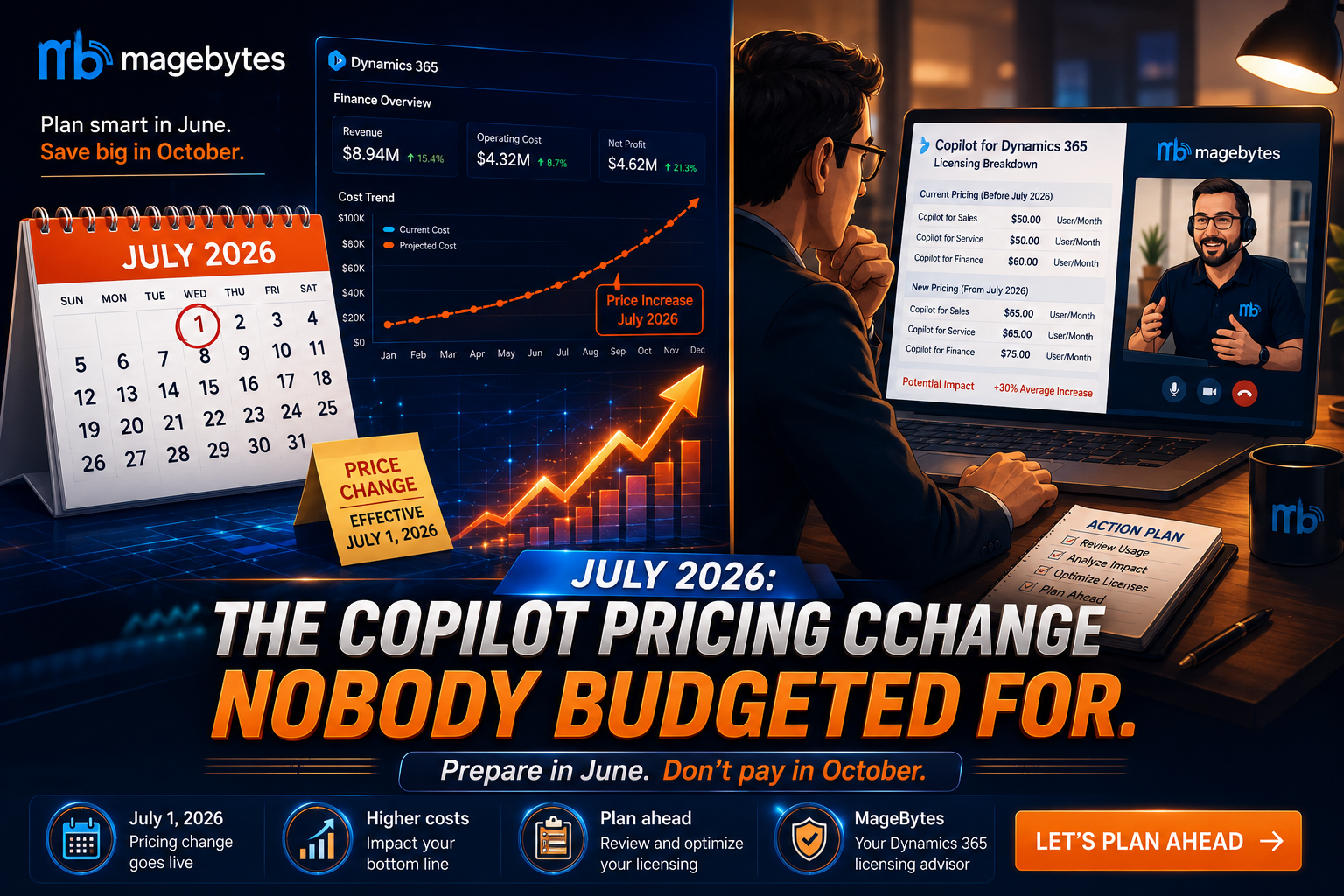
The changes landing on July 1, 2026 are not a single adjustment They span M365 suite pricing across Business and Enterprise tiers, the retirement of the SMB promotional Copilot rate, the formal launch of credit based agent billing through Copilot Credits, and a major restructuring of how agentic AI capabilities are licensed inside Dynamics 365. For any organization running Dynamics 365 for sales, customer service, finance, or supply chain, the downstream effect on total licensing cost is significant, and it compounds in ways that a surface-level read of Microsoft’s communications will miss
This blog breaks down exactly what is changing, what it will cost a real organisation, and what you need to do before July 1 to avoid the worst of it. If you manage a Salesforce CRM integration services comparison in your enterprise, or are evaluating your CRM stack more broadly, the licensing environment shift described here applies equally to decisions about enterprise CRM setup India deployments across the Microsoft ecosystem.
The Hard Deadline
July 1, 2026 is not a soft transition. M365 suite price increases take effect globally on that date. The SMB Copilot Business promotional rate of $18/user/month ends on June 30. Enterprise volume discounts on the $30 Copilot add-on also expire then. Organisations that renew before July 1 lock in current rates for the full new term. Organisations that renew after face the new pricing from their renewal date forward.
01 What Is Actually Changing on July 1, 2026
Three separate changes converge on July 1, and conflating them is the fastest way to either overprepare or be caught short. Here is each one separately.
M365 Suite Base Price Increases
Microsoft announced in December 2025 that commercial M365 plan prices are rising globally across Business, Enterprise, and Frontline tiers. The key figures, per user per month:
| Plan | Before July 1 | After July 1 | Change |
| M365 Business Basic | $6.00 | $7.00 | +$1.00 (+17%) |
| M365 Business Standard | $12.50 | $14.00 | +$1.50 (+12%) |
| M365 Business Premium | Stays same | Stays same | No change |
| M365 E3 | $36.00 | $39.00 | +$3.00 (+8%) |
| M365 E5 | $57.00 | $60.00 | +$3.00 (+5%) |
| M365 Copilot add-on (Enterprise) | $30.00 | $30.00 | No change |
| M365 Copilot Business (SMB promo) | $18.00 | $21.00 (post-promo) | +$3.00 (+17%) |
The critical nuance here: the Copilot add-on at $30/user/month is not changing. But because Copilot requires a qualifying M365 base plan, the total cost of a Copilot-enabled seat goes up regardless. An E3 user with Copilot moves from $66 to $69 per month. An E5 user with Copilot moves from $87 to $90. Multiply those numbers across 200 or 500 seats, and you are looking at a material annual cost increase that appeared in no budget planning document before December 2025.
Copilot for Sales SKU Retirement
Microsoft has retired the standalone Copilot for Sales license SKU. The capabilities it delivered, including CRM-connected meeting summaries within Teams and Outlook, pipeline coaching, and email drafting linked to Dynamics data, are now accessible only through the full Microsoft 365 Copilot license at $30/user/month. Organisations that were on the Copilot for Sales SKU at a lower price point now face a mandatory upsize to the full Copilot license to maintain the same functionality.
Copilot Credits and Agent Billing: The New Consumption Layer
This is the change that most organisations are least prepared for. Microsoft has introduced Copilot Credits as the metered billing unit for autonomous agent capabilities across Dynamics 365 and Microsoft 365 Copilot Cowork. This is an entirely new cost layer that sits on top of your per-user license, and it bills based on usage rather than headcount.
The economics work as follows: each autonomous agent trigger costs 25 Copilot Credits, which translates to $0.25 per action under pay-as-you-go billing. Dynamics 365 Premium SKU users receive a pool of 1,000 Copilot Credits per user per month at no additional cost, shared across the tenant. A 50-user Premium deployment gets a monthly pool of 50,000 credits, which covers approximately 2,000 autonomous agent actions before overage billing begins.
For organisations in early-stage Copilot adoption running a handful of agents for routine tasks, the included credits may be sufficient. For any organisation planning to deploy agents across multiple departments or automate high-frequency workflows, that ceiling can be reached faster than expected, and overage billing will kick in without a clear warning unless spending limits are configured in advance.
The Cowork Hard Cutoff
Microsoft 365 Copilot Cowork moved to general availability on June 16, 2026, and now bills through Copilot Credits separately from the per-user Copilot license. Critically: if usage-based billing is not configured in your Microsoft 365 admin center before July 1, 2026, your tenant loses access to Cowork entirely. Not partially. Not with a warning period. The access stops. No admin action means no Cowork.
02 The Real Cost Impact: Running the Numbers
Abstract percentages look manageable until you calculate them against your actual seat count. Here is what the July changes look like across three realistic organisational profiles.
Profile A: 50-User SMB on M365 Business Standard with Copilot Business
Currently on the promotional Copilot Business rate of $18/user/month plus Business Standard at $12.50/user/month. After July 1, Business Standard rises to $14.00 and the Copilot promo rate ends, moving to $21/user/month standard.
Previous monthly total: $1,525. New monthly total: $1,750. Additional annual cost: $2,700. That is a 14.8% increase on the combined cost, appearing at the next renewal after July 1.
Profile B: 150-User Mid-Market on M365 E3 with Copilot
Running E3 at $36/user/month plus Copilot at $30/user/month. E3 rises to $39/user/month after July 1. Copilot add-on price unchanged.
Previous monthly total: $9,900. New monthly total: $10,350. Additional annual cost: $5,400. Enterprise Agreement volume discounts also expire June 30 for some organisations, potentially compounding this figure toward a 20% effective increase.
Profile C: 300-User Enterprise on M365 E5 with Copilot and Agent Deployment
Running E5 at $57/user/month plus Copilot at $30/user/month, with Copilot Credits consumption running at 4,000 agent actions per month across five departments. E5 rises to $60/user/month. The included credit pool covers 2,000 of the 4,000 actions (300 Premium users receiving 300,000 credits, of which 100,000 are consumed, leaving 200,000 headroom for 8,000 agent actions). No overage in this example.
However, if agent usage scales to 10,000 actions per month, and overage is billed at $0.25 per action for the 2,000 excess, monthly agent overage adds $500. Annual: $6,000 in overage on top of a $10,800 base increase from E5 price movement.
This is where robust B2B CRM consulting India planning pays for itself. Modelling expected agent consumption against available credits before committing to a billing approach is the difference between a predictable AI budget and a finance team conversation nobody wants to have in Q4.
The Number Most Organisations Are Missing
Microsoft has approximately 450 million commercial M365 users. Only around 15 million hold paid Copilot seats, which is roughly 3%. That means an enormous number of organisations are still either on legacy Copilot SKUs, on the promotional rate about to end, or evaluating whether to activate Copilot at all. The worst position to be in on July 2 is having to make that decision under time pressure with a renewal notice already in your inbox.
03 Microsoft 365 E7: The New Frontier Tier and Whether You Need It
On May 1, 2026, Microsoft launched Microsoft 365 E7, branded as the Frontier Suite, at $99 per user per month. It bundles four components into one SKU: Microsoft 365 E5, Microsoft 365 Copilot, Agent 365, and the Microsoft Entra Suite.
After the July price increase, buying those four components individually would cost approximately $117 per user per month. E7 at $99 saves around $18 per user, roughly 15%. For organisations already running all four components separately, this is a genuine consolidation saving.
The trap is licensing E7 across the entire organisation when only a fraction of users will use Agent 365. The textbook overspend pattern here is blanket E7 deployment to unlock agentic features that 15% of the user base will actually touch. Buying E7 for a select cohort of power users while keeping the majority on E3 or E5 is almost always the better commercial decision.
Who E7 genuinely makes sense for:
- Organisations already on E5 plus Copilot where Agent 365 is actively planned within 12 months
- Teams building or deploying agents through Copilot Studio or Microsoft Foundry as a core workflow component
- IT departments wanting to consolidate E5, Copilot, Entra Suite, and Agent 365 billing into a single line item
- CSP channel customers where additional promotional discounts through December 2026 make the effective per-seat price even lower
Who should probably wait on E7:
- Organisations where Copilot adoption is still experimental or under 30% of licensed users are active
- Large enterprise deployments of 5,000 or more seats where a mixed-tier model saves meaningfully more than blanket E7
- Businesses where the AI agent roadmap is genuinely 24 to 36 months out — Agent 365 is available as a $15/user standalone when you are ready
The decision depends entirely on your actual usage patterns, not your aspirations. This is exactly where an objective enterprise CRM setup India review from a partner who does not have a direct incentive to push you toward the most expensive bundle becomes valuable
04 How Copilot Credits Work Inside Dynamics 365
For Dynamics 365 specifically, the Copilot Credit model creates a new budget variable that most finance and IT teams have not yet built into their planning. Here is how it works in practice.
What consumes Copilot Credits in Dynamics 365:
- Autonomous agent triggers: Each action completed by an autonomous agent costs 25 credits ($0.25). An agent that processes incoming service requests, categorises them, and routes them counts one trigger per completed action.
- Multi-step agent workflows: Complex agents that call multiple tools, retrieve large amounts of organisational context, or run for extended periods consume more credits per run than simple single-step agents.
- Copilot Studio agents published to external channels: Agents deployed to websites, customer portals, or social platforms consume credits at a higher rate than internal employee-facing agents.
- Copilot Cowork task execution: Long-running multi-step tasks inside M365 Copilot now bill through Copilot Credits separately from the per-user license fee, as of general availability on June 16, 2026.
What does NOT consume Copilot Credits:
- Standard Copilot Chat inside Dynamics 365 Sales, Customer Service, or Business Central when using the built-in embedded Copilot
- Meeting prep summaries, email drafting, and conversational CRM queries included with Dynamics 365 Enterprise or Premium licenses
- Internal agent interactions built in Copilot Studio for employee use within your M365 tenant, covered by the per-user Copilot license
Choosing between pay-as-you-go and prepaid credits:
Pay-as-you-go billing requires no upfront commitment and charges only for credits consumed at the end of each billing period. It requires an active Azure subscription. This is the right starting point for organisations in early adoption stages where monthly usage is variable and hard to predict.
Copilot Credit Commit Units are prepaid credit blocks that offer discounts of up to 20% versus pay as you go rates. The minimum annual purchase is $2,850. Copilot Studio capacity packs come in blocks of 25,000 credits at $200 per pack per month at the tenant level. Prepaid plans make sense once your agent usage is predictable enough to model accurately, typically after three to six months of pay-as-you-go billing data.
Governance Warning
Without per user monthly spending limits set in the Microsoft 365 admin center, a single user or team running intensive agent workflows can consume credits allocated across the entire organisation. Microsoft does not cap consumption automatically. Spending limits are an administrative configuration, not a default state. They must be turned on before agent use scales, not after the first overage invoice arrives.
Organisations running n8n workflow automation or exploring custom AI solutions India outside the Microsoft stack should factor the Copilot Credit model into their build-versus-integrate decision for AI agent workflows. For some use cases, a purpose-built automation layer outside M365 carries more predictable per-action costs than the credit consumption model, particularly for high-frequency, low-complexity tasks.
05 The Dynamics 365 Copilot Feature Shift: What Is Included Now
One positive aspect of the July changes: Microsoft has simplified where Copilot capabilities sit relative to Dynamics 365 licenses. Basic AI features that previously required separate licensing decisions are now bundled into the core Dynamics 365 app licenses.
Included in Dynamics 365 Enterprise licenses (at no extra Copilot cost):
- AI-generated meeting prep summaries before customer and stakeholder calls
- Real-time coaching and suggestion surfaces during Teams sales calls
- Email drafting with CRM context pulled from Dynamics data
- Conversational CRM queries in natural language inside the D365 client
- Pipeline health summaries and deal risk signals in Sales
- Case summarisation and suggested responses in Customer Service
Requires M365 Copilot license at $30/user/month in addition to D365:
- CRM-connected meeting summaries surfaced in Outlook and Teams (previously covered by Copilot for Sales SKU, now requires full M365 Copilot)
- Copilot Chat with full Microsoft 365 grounding across email, calendar, documents, and SharePoint
- Copilot capabilities within Word, Excel, PowerPoint, and Outlook tied to organisational data
- Work IQ personalisation layer that builds implicit understanding of your working patterns and relationships over time
Requires Copilot Credits on top of both licenses:
- Autonomous agents that execute multi-step workflows without human prompting
- Customer-facing agents deployed through Copilot Studio to external channels
- Copilot Cowork task execution for long-running, background task processing
For organisations running Zoho CRM customization steps or evaluating a migration from alternative CRM platforms, the bundling of embedded AI into Dynamics 365 Enterprise licenses strengthens the total value case for the Microsoft stack. The question is not whether the features are there; it is whether your organisation will actually use them, and whether the total licensing cost at scale remains competitive versus building equivalent capabilities on a separate CRM with a custom AI integration layer.
06 Your Pre-July Action Plan: Seven Steps to Take This Week
The window to act before July 1 is narrow. Here is the practical sequence, in order of urgency
Step 1: Find Your Renewal Date
This is the single most important data point. If your M365 renewal falls before July 1, you can lock in current pricing for the full new term. If it falls after July 1, you face new pricing from renewal date forward. Log into the Microsoft 365 admin center and check Billing, then Your Products to confirm the exact renewal date for every relevant subscription.
Step 2: Run a Seat Audit
The majority of B2B CRM consulting India reviews we run on Microsoft environments find the same pattern: departed employees still assigned to E5 and Copilot seats, users assigned licenses they have never opened, and Copilot seats allocated broadly before any adoption plan was in place. Pull a sign-in activity report from the M365 admin center covering the past 90 days. Any user with zero sign-in activity on a Copilot-enabled seat is paying for something nobody is using. Eliminate those before the renewal baseline is calculated.
Step 3: Model Your Copilot Credit Consumption
If your organisation has autonomous agents running in production, or plans to deploy them before the end of the year, you need a consumption model before July 1. Estimate the number of agent actions per day across each deployed agent, multiply by 25 credits per action, and compare against your included credit pool. If you will exceed the pool consistently, prepaid credits at a discount will cost less than pay-as-you-go overage over a full year.
Step 4: Configure Copilot Cowork Billing (Hard Deadline: July 1)
If your tenant is using or plans to use Copilot Cowork for automated background tasks, a Microsoft 365 admin must explicitly enable usage-based billing and set spending limits in the admin center before July 1, 2026. Missing this deadline means losing Cowork access entirely, not receiving a grace period. Set per-user monthly spending limits at the same time to prevent uncontrolled credit consumption.
Step 5: Evaluate Your Plan Mix with July Pricing
The narrowing price gap between Business Standard and Business Premium, the addition of Defender for Office 365 Plan 1 to E3, and the Security Copilot inclusion in E5 all change the comparative value proposition of different tiers. Run the comparison again with post-July pricing. Organisations that were borderline between E3 and E5 may find that the new feature inclusions shift the calculation.
Step 6: Assess E7 Against Your Actual Agent Roadmap
Not aspirational plans. Actual deployed or firmly planned agent use within the next 12 months. If Agent 365 is a real near-term requirement and you are already on E5 plus Copilot, the E7 math is worth running. If agent deployment is speculative, lock in current E5 or E3 pricing now and revisit E7 when the roadmap is concrete.
Step 7: Explore a Three-Year Renewal to Lock Current Rates
Under Microsoft’s New Commerce Experience, committing to a three-year term before July 1 locks your current pricing for the full duration. For E3 users, that avoids the $3/user/month increase for three years. At 200 seats, that is a $21,600 saving over the term versus renewing annually after July 1. The trade-off is the commitment length, and it is worth modelling against your infrastructure plans for the period.
07 ERP and CRM Teams: The Integration Implications
The July changes are not only a licensing conversation. They affect how AI capabilities integrate with the operational systems your business runs on, and those implications are worth planning for alongside the budget decisions.
For Dynamics 365 Finance and Supply Chain teams:
The shift to Copilot Credits for autonomous agents means that any Odoo ERP implementation or custom ERP systems India project that involves AI-driven automation or a Microsoft-adjacent integration needs to factor agent billing into the total cost of ownership from day one. Teams building ERP workflows that trigger Dynamics 365 agents, retrieve data from Dataverse, or call Microsoft Foundry models will consume Copilot Credits whether or not the primary ERP platform sits inside the Microsoft stack.
For CRM and sales teams evaluating platform decisions:
The embedded Copilot features now included in Dynamics 365 Enterprise licenses strengthen the Microsoft CRM proposition relative to Salesforce CRM integration services or Zoho CRM customization steps alternatives. However, the total cost of a Copilot-enabled Dynamics 365 seat, base license plus M365 plus Credits, must be evaluated honestly against the all-in cost of CRM alternatives with their own AI layers. The features comparison is no longer straightforward when both platforms are adding AI capabilities at speed.
For data and analytics teams:
Work IQ, the intelligence layer now bundled with M365 Copilot, connects to Dataverse and pulls context from line-of-business data through Copilot connectors. For organisations running Microsoft Power BI dashboards across their Dynamics data, the July changes actually expand what Work IQ can surface by default, which is a genuine value addition for data analytics solutions India teams already invested in the Microsoft data stack.
The Honest Summary
July 1 is not the end of the world for Dynamics 365 teams. The core Copilot capabilities inside D365 are getting more accessible, not less. The embedded AI features included with Enterprise licenses are genuinely useful, and the simplification of the Copilot for Sales licensing situation removes a decision that was previously confusing.
The challenge is the convergence of multiple cost variables at the same moment: rising M365 base prices, the end of promotional rates, the retirement of lower-cost SKUs, the arrival of a new credit-based billing layer, and a major new bundle tier to evaluate. Any one of those changes would warrant a planning conversation. All of them landing simultaneously, in an environment where most organisations have not modelled the combined impact, is where budget surprises come from.
The organisations that come through July in a controlled position are the ones doing the analysis now, not at renewal time. Whether you are optimising an existing enterprise CRM setup India deployment, building AI agent workflows on top of Dynamics 365, or evaluating the Microsoft stack against Salesforce CRM integration services alternatives, the conversation starts with understanding exactly what you have, what you use, and what July changes cost you in actual dollars.
MageBytes works with enterprise and mid-market teams across India and internationally as a software and e-commerce development company in India with deep experience in Microsoft ecosystem architecture, CRM integration, and enterprise technology strategy. Our team does not sell Microsoft licenses; we help you understand your real exposure and build a preparation plan that fits your renewal timeline and growth roadmap.
The window before July 1 is narrowing. A conversation now costs nothing. The alternative costs more than that.
Your Dynamics 365 Licensing Review Starts Here
The July deadline is closer than it looks. MageBytes helps Dynamics 365 teams model their real exposure,
right-size their Copilot seats, and lock in the best available terms before the pricing clock runs out
Book a Free Licensing Review with MageBytes