Headless commerce is one of those architectural decisions that sounds like a clear upgrade until you sit down and start pricing out the implementation.
The pitch is compelling: decouple your frontend from your commerce backend, build your storefront in Next.js, serve everything through a GraphQL layer, and unlock blazing-fast page speeds, complete design freedom, and the ability to deliver consistent experiences across web, mobile, kiosks, and whatever surface comes next.
The reality is more nuanced. Headless commerce with Next.js is genuinely the right architecture for a specific set of businesses and requirements. For a different set, it adds months of engineering effort, a permanently larger infrastructure footprint, and organisational complexity that never fully goes away. The decision depends on what you are building, how fast your team moves, and what you are willing to maintain.
This blog covers the technical architecture in depth, walks through the real trade-offs, and gives you a clear framework for deciding whether headless is the right direction for your store. If you want to talk through your specific situation after reading, the MageBytes team is available for a free architecture review with no sales pressure attached.
01 What Headless Commerce Actually Means
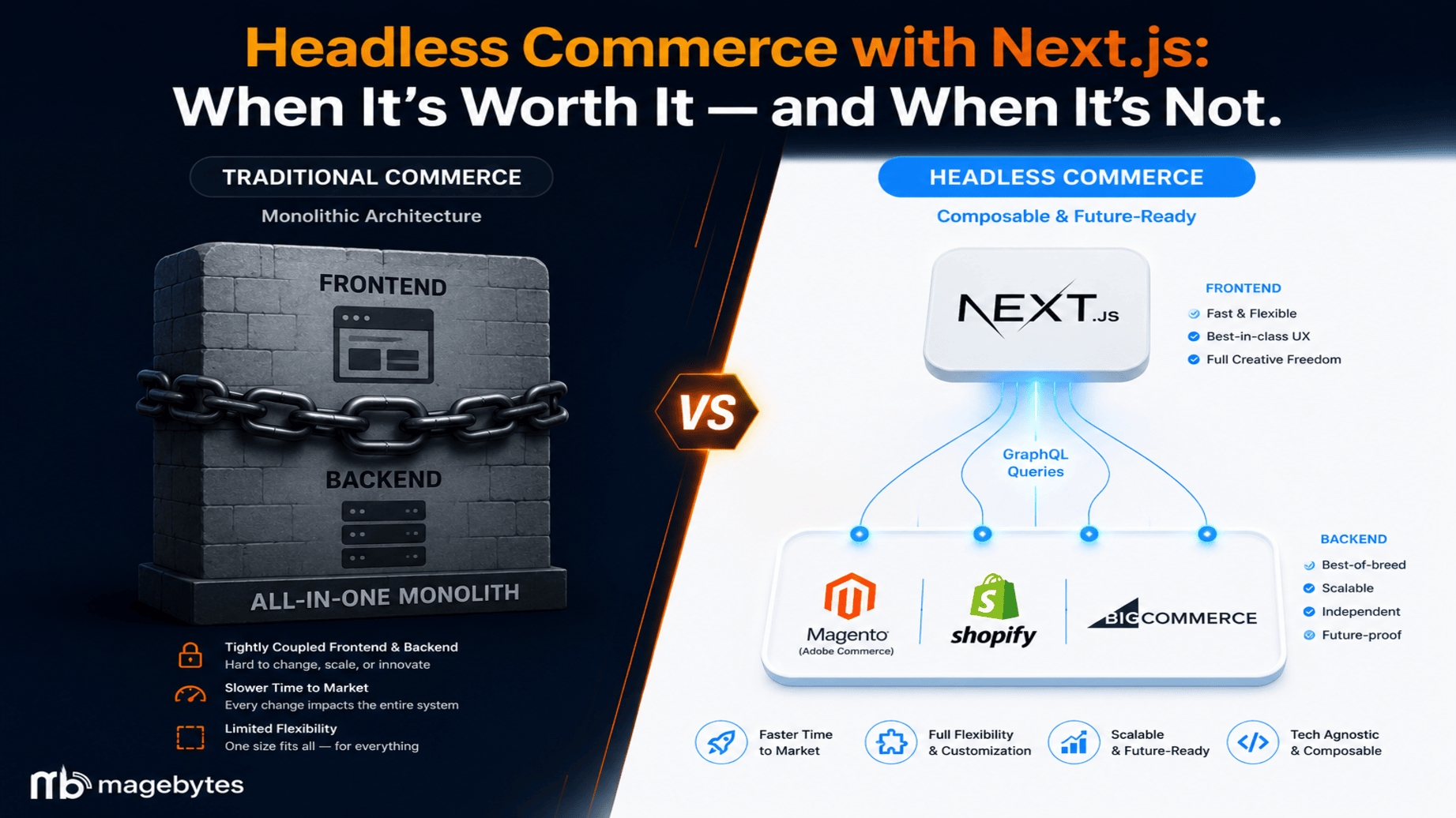
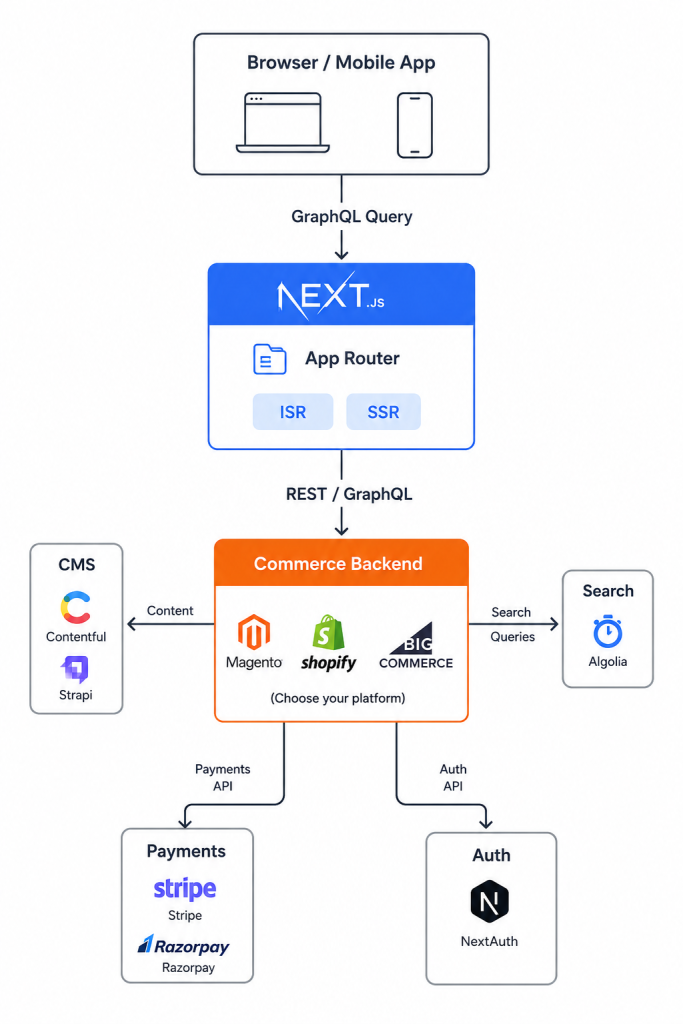
Headless commerce is an architecture pattern where the frontend (the head) is completely separated from the commerce backend. They communicate through APIs, typically REST or GraphQL. Neither side knows anything about the other’s implementation details.
In a traditional monolithic setup, your Magento or Shopify theme is tightly coupled to the backend. The PHP template for a Magento PDP (Product Detail Page) lives inside the Magento codebase. Shopify’s Liquid templates render directly from the Shopify backend. Changing the frontend means working within the constraints of that system.
In a headless setup, your Next.js application is an independent project. It makes API calls to your commerce backend to retrieve product data, prices, inventory, cart state, and order information. It renders those responses however it wants, using React components, with full control over routing, rendering strategy, and performance optimisation. The commerce backend becomes an API server. The frontend becomes an independent application.
The GraphQL Layer
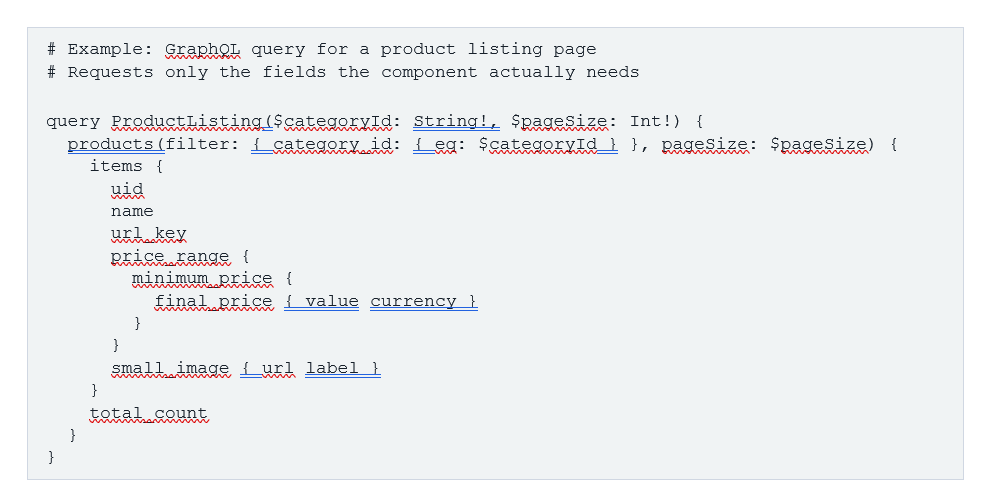
Most production headless implementations use GraphQL rather than REST for the primary data layer, and for good reason. GraphQL lets the frontend request exactly the fields it needs for each component, eliminating the over-fetching that comes with REST endpoints designed for broad use cases.
A product listing page in a headless storefront might send a single GraphQL query that returns exactly the product name, thumbnail URL, price, and slug for the first 24 products in a category. No excess payload. No additional requests. On a category page with 48 products, that efficiency difference versus a REST endpoint returning full product objects can cut response payload size by 60 to 80 percent.
Where Next.js Fits
Next.js has become the dominant framework for headless commerce frontends because it solves the fundamental tension between frontend performance and SEO. A pure client-side React application renders in the browser, which means search engine crawlers see an empty page until JavaScript executes. For ecommerce development services where product discoverability through organic search drives a significant share of revenue, that is an unacceptable trade-off.
Next.js resolves this through a combination of rendering strategies that you can apply at the page or even component level:
- Static Site Generation (SSG): Pages are rendered at build time and served as static HTML. Product detail pages for a stable catalogue are excellent SSG candidates: fast to serve, SEO-ready, cacheable at the CDN edge globally.
- Incremental Static Regeneration (ISR): A refinement of SSG where static pages are regenerated in the background after a revalidation interval, or on-demand via a webhook trigger. A product page that changes price daily uses ISR to stay current without a full site rebuild.
- Server-Side Rendering (SSR): Pages are rendered on each request. Used for pages where data must be fresh on every load: cart pages, account pages, personalised recommendations, checkout. The performance cost is real and must be managed through caching and infrastructure sizing.
- React Server Components (App Router): Next.js 13 and later ship the App Router with React Server Components, allowing you to run data fetching logic on the server inside individual components rather than at the page level. This reduces client bundle size significantly and removes the need for many client-side state management patterns.
| Why This Rendering Flexibility Matters for Commerce A typical ecommerce store has pages with very different data characteristics. Your homepage might be static and change twice a week. Your category pages update daily with new products and pricing. Your product pages are mostly stable but prices shift with promotions. Your cart is fully dynamic and personalised. A headless Next.js storefront can apply the optimal rendering strategy to each page type independently. A traditional monolithic theme applies the same strategy to everything. |
02 The Composable Commerce Stack: What Headless Unlocks
Going headless opens the door to what the industry calls composable commerce: a best-of-breed architecture where each layer of your stack is independently chosen, independently deployed, and connected through APIs. Instead of one monolith doing everything, you assemble specialised tools for each function.
A mature composable commerce stack built on Next.js might look like this
| Layer | What It Does | Common Tools |
| Frontend | Renders UI, handles routing and UX | Next.js (App Router), React |
| Commerce Engine | Products, cart, checkout, orders | Magento, Shopify, BigCommerce, Shopware |
| CMS / Content | Editorial content, landing pages, banners | Contentful, Sanity, Strapi, Builder.io |
| Search | Product discovery, faceted search, AI recommendations | Algolia, Meilisearch, Elastic |
| Payments | Transaction processing, fraud, BNPL | Stripe, Razorpay, PayU, Braintree |
| Auth / Identity | Login, SSO, customer sessions | NextAuth.js, Auth0, Clerk |
| Personalisation | Segment-level and 1:1 experiences | Bloomreach, Dynamic Yield |
| CDN / Edge | Asset delivery, caching, A/B testing at edge | Vercel Edge, Cloudflare, Fastly |
The advantage of this architecture is that each layer is replaceable independently. If you switch payment processors, only the payment integration changes. If you migrate from Contentful to Sanity for your CMS, the commerce backend is untouched. If you swap from Shopify to Magento as your commerce engine, your Next.js frontend continues to function with updated API calls.
MageBytes has built headless storefronts connecting Next.js frontends to Adobe Commerce backends with GraphQL, to Shopify Plus via the Storefront API, to BigCommerce via its native headless API, and to headless Shopware setups using Shopware’s composable frontend architecture. Each has its own API maturity level and GraphQL implementation quality, and those differences matter for implementation complexity and ongoing maintenance.
03 The Real Performance Numbers
The performance argument for headless is real, but it needs to be grounded in specifics rather than marketing language. Here is what headless with Next.js actually delivers when implemented correctly, and what it does not.
What you genuinely gain:
- Core Web Vitals improvement: A well-implemented Next.js storefront consistently scores higher on LCP, CLS, and INP than a traditional Magento Luma or legacy Shopify theme. The primary reason is control: you decide exactly what JavaScript loads, when, and how. There are no inherited theme dependencies pulling in scripts you did not choose.
- Time to First Byte (TTFB) on static and ISR pages: Pages generated at build time and served from a CDN edge node have TTFB values under 50ms, often under 20ms. Compare that to a server-rendered Magento page that must query the database and execute PHP before serving a response, even with FPC: typical TTFB of 200 to 600ms on standard infrastructure.
- JavaScript bundle size control: React Server Components in Next.js 13 and later move data-fetching logic to the server and prevent those components from contributing to the client bundle. A headless storefront built with RSC discipline can have a significantly smaller JavaScript footprint than a traditionally themed store with accumulated third-party scripts.
- Selective hydration: Next.js allows you to ship HTML to the browser and hydrate individual interactive components independently. The product image gallery becomes interactive without waiting for the entire page to hydrate. This is a measurable improvement to Interaction to Next Paint scores on large PDPs.
What the performance case does not automatically give you:
- SSR pages are not inherently faster than traditional backends: A Next.js page using getServerSideProps or a Server Component that makes multiple API calls before rendering still has latency. If your backend API response time is 800ms, your SSR page TTFB is at least 800ms plus server processing. The frontend framework does not compensate for a slow API layer.
- Build times become a concern at scale: SSG is fast to serve but slow to generate on large catalogues. A catalogue of 50,000 products with SSG means 50,000 pages built on every deployment. ISR addresses this for most cases, but the build pipeline still needs to be designed carefully.
- The Vercel cost equation: Many headless Next.js implementations deploy to Vercel for simplicity. Vercel’s pricing is consumption-based, and at high traffic volumes the cost can exceed what a well-configured dedicated cloud would cost. Factor this into TCO calculations before committing to the hosting model.
| Benchmark Reference: Headless Magento vs. Hyvä Theme MageBytes has implemented both headless Next.js frontends for Magento and Hyvä Theme migrations for stores that wanted dramatic frontend performance improvements without full decoupling. For the majority of Magento stores, Hyvä delivers 70 to 80 percent of the frontend performance gain of headless at roughly 30 percent of the implementation cost and complexity. If your primary motivation for going headless is performance, a Hyvä migration is worth serious consideration before committing to a full headless architecture. |
04 When Headless Commerce Is Genuinely Worth It
There are clear business and technical scenarios where headless with Next.js is the right architectural choice, and the investment is justified by what you get in return.
Omnichannel or Multi-Surface Commerce
If your product or brand needs to deliver a consistent commerce experience across a website, a native mobile app, a kiosk, a voice interface, or a third-party marketplace, headless is the correct architecture. The commerce backend becomes a single source of truth. Each surface is a separate frontend application that reads from the same API. Inventory, pricing, and order management sit in one place. Each channel consumes that data in the format it needs.
This is a common pattern in the projects MageBytes builds for clients running mobile application development alongside their web store. A Flutter mobile app and a Next.js web storefront can both consume the same Magento or Shopify GraphQL API. One backend. Two frontends. Zero duplication of commerce logic.
High Editorial Velocity with Deep Commerce Integration
Brands that publish a significant volume of content alongside commerce, think large fashion retailers with editorial lookbooks, outdoor brands with gear guides, or B2B brands with technical documentation, need a CMS that editorial teams can use freely without engineering involvement for every update. In a monolithic Magento or Shopify setup, this is awkward: page builders exist but have layout constraints, and content updates often require developer time for anything non-trivial.
In a headless setup, the CMS is an independent system. A Contentful or Strapi editor can build a campaign landing page, embed product components from the commerce API, schedule it, and publish it without touching the commerce backend or requiring a deployment. The Next.js frontend fetches from both systems and renders them together. This editorial independence is a significant operational advantage at scale.
Performance-Critical High-Traffic Stores
Stores with consistent high organic traffic where Core Web Vitals directly affect search ranking and revenue should take the headless performance case seriously. When a category page generated at build time and served from a CDN edge in Mumbai or Singapore is the first thing 10,000 concurrent visitors receive in under 50ms, the performance gap versus a server-rendered response from a single-region origin server is commercially meaningful. For enterprise ecommerce development at that traffic level, the conversion rate lift from performance improvements typically justifies the architectural investment.
Custom Design Systems That Cannot Be Built Within Theme Constraints
Some brands have design systems, animation requirements, or interaction patterns that simply cannot be implemented cleanly within the constraints of a Magento theme or Shopify Liquid template. The workarounds involve overriding core theme files, injecting JavaScript at points not intended for customisation, and creating fragile implementations that break on platform updates.
A Next.js frontend with a custom Shopify Storefront API integration or a custom Shopify store design built headless gives the frontend team complete control over the component tree, animation library, layout system, and CSS approach. If your brand requires a genuinely distinctive experience that a theme cannot deliver cleanly, headless is the path forward.
B2B Commerce with Complex Personalisation Requirements
B2B ecommerce often involves pricing rules that vary by customer account, catalogue segments that differ by buyer, approval workflows that are unique to each organisation, and portal experiences that look nothing like a standard storefront. These requirements push the limits of what monolithic themes were designed to handle.
A headless architecture where the Next.js frontend can fetch customer-specific pricing from the commerce API, render different catalogue views based on account tier, and integrate with Salesforce CRM integration or a custom ERP for approval workflow data gives B2B commerce teams the flexibility that monolithic themes genuinely cannot provide.
05 When Headless Is Overkill (Be Honest With Yourself)
The harder conversation is the one where headless is the wrong choice. The industry press and technology vendors have strong incentives to make every commerce story sound like a headless story. The reality is that for a significant portion of ecommerce businesses, headless adds cost and complexity without returning proportionate value.
Your team does not have dedicated frontend React engineers
Headless Next.js requires a frontend team that is proficient in React, familiar with Next.js’s rendering model, comfortable debugging SSR versus CSR behaviour, and capable of maintaining a GraphQL client layer. If your current team runs on PHP, manages Magento through admin panels, and has one or two developers who handle occasional theme customisations, headless is not a frontend upgrade. It is a complete technology stack change that requires either significant hiring or a long-term partnership with an agency that owns the frontend permanently.
The ongoing cost of headless is not the implementation. It is the maintenance model. The Next.js ecosystem moves fast. The App Router introduced breaking changes. React itself evolves. Someone on your team or in your agency relationship needs to keep the frontend current, and that is a permanent operational cost.
You are early-stage and your primary need is speed to market
If you are launching a new store and the primary objective is to be in market with a validated product in 60 to 90 days, headless is the wrong starting point. A well-configured Shopify store or a clean Magento setup gets you to market faster, costs less to launch, and can be migrated to a headless architecture later if the business grows to a point where it justifies the investment.
The Shopify development company India path to launch is genuinely fast when done correctly. A thoughtfully configured Shopify Plus store with custom theme development delivers an excellent customer experience and solid performance without the architecture overhead. Start there. Migrate when the business demands it.
Your catalogue is small and relatively stable
Much of the headless performance advantage comes from static generation of product and category pages. If your store has 200 products and a relatively slow-moving catalogue, the ISR and SSG benefits are real but the delta versus a fast monolithic setup with a CDN in front of it is modest. The performance case does not justify headless complexity when a Hyvä theme migration or a properly configured Varnish cache would achieve similar results at a fraction of the effort.
You need to move fast on commerce features
Headless shifts feature development responsibility. When Shopify releases a new checkout feature, a monolithic Shopify merchant gets it by default or with a few configuration changes. A headless Shopify merchant needs to implement support for that feature in their custom Next.js checkout. The same applies to Magento extensions, Shopify apps, and BigCommerce marketplace solutions. The composability that makes headless powerful also means you own the integration work for every commerce capability your monolithic peers receive automatically.
If your roadmap for the next 12 months is driven by commerce functionality rather than frontend experience innovation, headless may slow you down rather than accelerate you.
The SEO complexity is underestimated
Next.js solves the fundamental SEO problem of client-side React. It does not eliminate SEO complexity. A headless storefront introduces new failure modes: build failures that prevent ISR regeneration and serve stale pages, misconfigured robots.txt or sitemap generation, canonical URL mismatches between the Next.js routing and the commerce backend URL structure, and structured data (JSON-LD) that must be manually implemented for every page type rather than inheriting what the commerce platform generates.
A development team inexperienced with headless SEO implementation can ship a technically beautiful Next.js storefront that loses organic search rankings because product pages are not being indexed correctly, structured data is missing, or internal linking patterns from the CMS layer are creating duplicate content issues. These problems are entirely solvable, but they require deliberate attention and testing.
06 The Technical Complexity Breakdown
For engineering teams doing honest technical planning, here is what the implementation surface area of a headless Next.js storefront actually looks like.
Cart and checkout: the hardest part
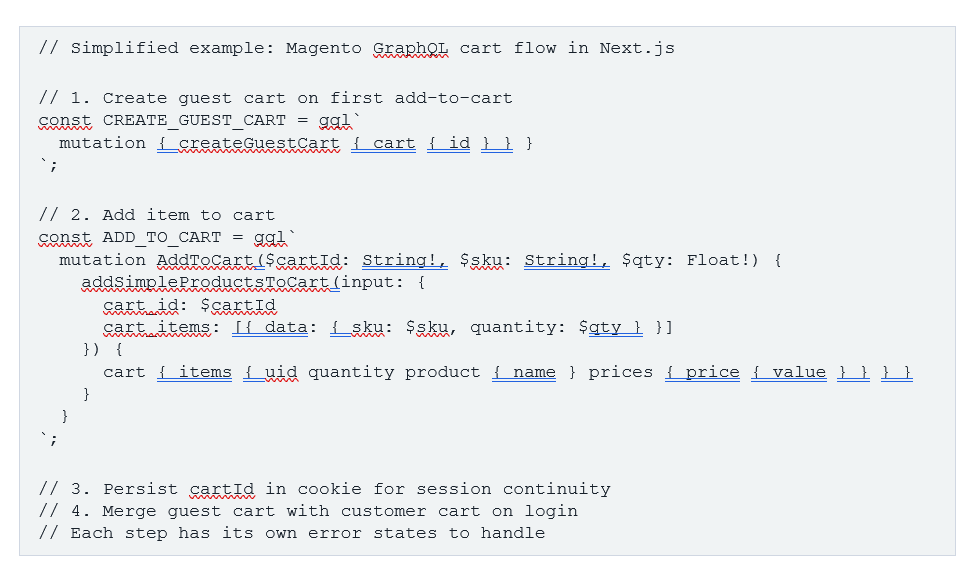
Cart and checkout in a headless implementation are the most complex components to build correctly and the area where most underestimated projects run into trouble. In a monolithic setup, the cart is owned by the platform. In headless, you are building or heavily customising the cart experience from scratch.
Considerations that teams frequently underestimate:
- Cart state persistence across sessions and devices requires careful session management, typically through a combination of cookies for anonymous carts and account-linked carts for logged-in customers
- Guest checkout versus account checkout flows have meaningfully different API interaction patterns and must both be fully implemented and tested
- Coupon code application, shipping method selection, and tax calculation all involve sequential API calls where error handling at each step is critical
- Payment gateway integration in a headless checkout means implementing the gateway’s JavaScript SDK in a context where you control the DOM entirely, including handling 3D Secure redirects without breaking your checkout flow
- Order confirmation and post-purchase flows, including email triggers and account creation for guest checkout, must be explicitly connected and tested
Authentication and session management
A monolithic platform handles authentication natively. In headless, you choose your auth solution and integrate it with your commerce backend. NextAuth.js is the most common choice for Next.js applications, but connecting it to Magento customer tokens or Shopify customer accounts requires custom provider configuration. Session tokens from your auth layer must match what the commerce backend expects on authenticated API calls. Token expiry and refresh flows must work seamlessly across page navigations and server/client component boundaries.
Search integration
Native search in most commerce platforms does not perform adequately in a headless context where search must respond in under 200ms to feel fast. Most headless storefronts replace the native search with Algolia, Meilisearch, or a similar dedicated search service. This adds the integration cost of syncing your product catalogue from the commerce backend to the search index, implementing faceted filtering on the search API’s terms rather than the commerce platform’s layered navigation, and keeping the index current as products, prices, and inventory change. For full stack web development India teams building headless for the first time, the search integration frequently takes longer than estimated.
Internationalisation If your store serves multiple countries with different languages, currencies, and tax rules, headless Next.js handles i18n at the routing layer through its built-in internationalisation support. However, the commerce backend must still serve locale-specific data, and the coordination between Next.js locale routing and commerce backend locale parameters adds integration complexity that compounds with each market you add.
07 What a Production Headless Next.js Setup Looks Like
Here is a direct verdict for common headless commerce decision scenarios based on what we have seen work and not work across real implementations
For teams in the evaluation phase, here is a reference for what a production-grade headless setup requires, not a minimal proof-of-concept, but a system that can be maintained and scaled over time.
Infrastructure and deployment:
- Next.js application: Deployed to Vercel (simplest for teams without dedicated DevOps) or a containerised deployment on AWS ECS, GCP Cloud Run, or equivalent. Edge runtime deployment for latency-sensitive pages where possible.
- Commerce backend API: Magento on managed cloud with Elasticsearch, Redis for FPC, and properly sized application servers. Shopify Plus with Storefront API access and webhook infrastructure for ISR invalidation. BigCommerce with its native headless API enabled.
- CDN and edge caching: Static and ISR pages cached at the CDN edge. Cache invalidation webhooks from the commerce backend to trigger ISR revalidation when products, prices, or inventory change.
- GraphQL client: Apollo Client or urql for the React layer. GraphQL Code Generator to produce TypeScript types from your commerce backend schema, eliminating an entire class of runtime type errors.
- State management: Zustand or Jotai for client-side cart and UI state. Avoid Redux for new headless projects unless the team already has deep Redux experience; the overhead rarely justifies itself in a Next.js App Router context.
Testing and quality:
- Playwright for end-to-end tests covering the complete purchase flow: browse, add to cart, checkout, payment, order confirmation
- Lighthouse CI in your deployment pipeline with performance budgets that fail the build if Core Web Vitals scores drop below defined thresholds
- GraphQL schema validation to catch breaking API changes from commerce backend updates before they reach production
- Visual regression testing (Percy or Chromatic) for components that feed high-revenue pages
Observability:
- Real User Monitoring through Vercel Analytics, Datadog RUM, or equivalent to track actual Core Web Vitals across real devices and network conditions
- Error tracking through Sentry with source maps for both client and server-side code, filtered to surface checkout and payment flow errors immediately
- API latency monitoring on the commerce backend calls that feed SSR pages, with alerting when backend response times cause TTFB degradation
MageBytes engineering teams follow this reference architecture on client headless projects. If you want to see how this maps to your specific backend platform and requirements, our ecommerce development team can walk through a detailed architecture review scoped to your catalogue size, traffic level, and team structure.
The Honest Summary
Headless commerce with Next.js is not universally better than a well-built monolithic storefront. It is the right answer for a specific set of requirements, and it is the wrong answer for a different set. The industry has a habit of presenting it as an inevitable architectural evolution rather than a deliberate trade-off decision, which leads teams into implementations they are not equipped to maintain.
The questions that actually determine whether headless is right for you are not about what is technically possible. They are about what your team can own, what your roadmap demands, and what the difference in customer experience is actually worth. A headless architecture that delivers 40ms TTFB on category pages, complete design freedom, and true editorial independence is worth the investment when those things directly impact your commercial outcomes. When they do not, a Hyvä migration, a well-configured theme, or a leaner PWA approach often delivers better results with less ongoing friction.
If you are in the middle of this decision and want an honest view from a team that has built both headless and coupled storefronts across Magento, Shopify, BigCommerce, and Shopware, get in touch with the MageBytes team. We will tell you what we actually think, not what fits a particular sales narrative.
Thinking About Going Headless?
Let MageBytes assess your current architecture and give you an honest view of whether headless commerce
with Next.js is the right move for your business right now, or what the smarter path actually looks like.Get a Free Headless Architecture Review