Magento vs Shopify vs BigCommerce vs WooCommerce, and When to Bring In Managed DevOps and CRM/ERP Support
The question sounds simple enough. Which ecommerce platform should we build on?
Ask five developers and you will get five different answers, each one delivered with complete confidence. Ask five agencies and the answer almost always defaults to whatever platform that agency is most comfortable selling. Neither is particularly useful when you are the one who has to live with the decision for the next four to seven years.
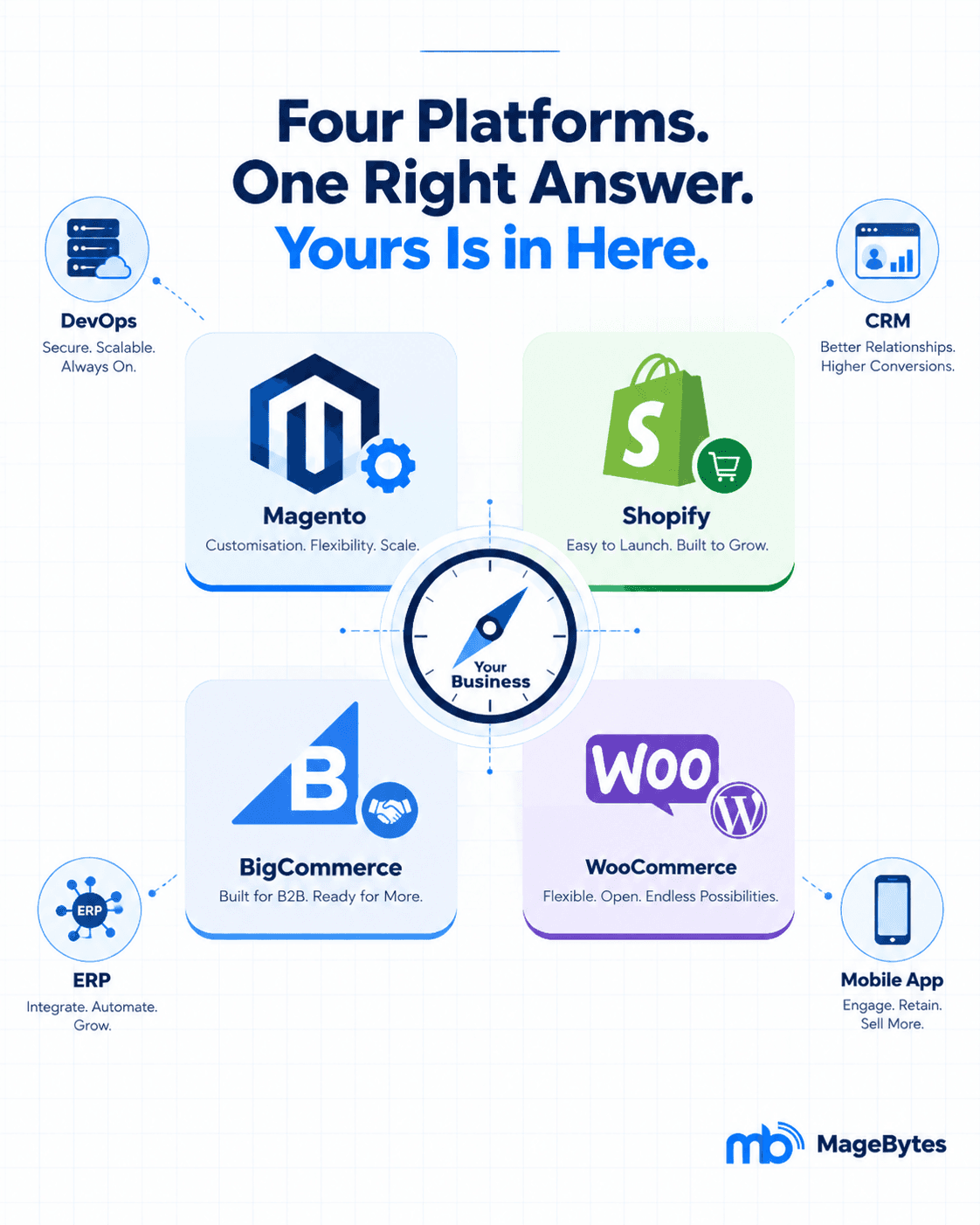
This piece tries to be more honest than that. Magento, Shopify, BigCommerce, and WooCommerce each have real strengths and real limitations. The right choice depends on specifics that a generic comparison article cannot resolve: how technically complex your product catalogue is, whether you are serving businesses or consumers, how fast you need to be in market, and what your team is actually capable of owning long term.
The second half of this blog covers something most platform selection guides skip entirely: when the platform decision itself is only half the problem. Businesses that have successfully launched often come back six or twelve months later with a different set of issues. Deployments breaking under load. Customer data fragmented across tools that do not talk to each other. Operations teams manually reconciling between a store and an ERP that were never connected. Those are not platform problems. They are infrastructure and systems problems, and they need a different conversation.
MageBytes works with growing ecommerce businesses across all four platforms as an ecommerce website development company with over twelve years of delivery across 30 countries. What follows is what we actually tell clients before they commit to a direction.
Part One: Choosing the Platform
The four platforms are not competing for the same market. They have genuinely different sweet spots, and the confusion in most comparisons comes from treating them as interchangeable options differentiated only by price and feature count.
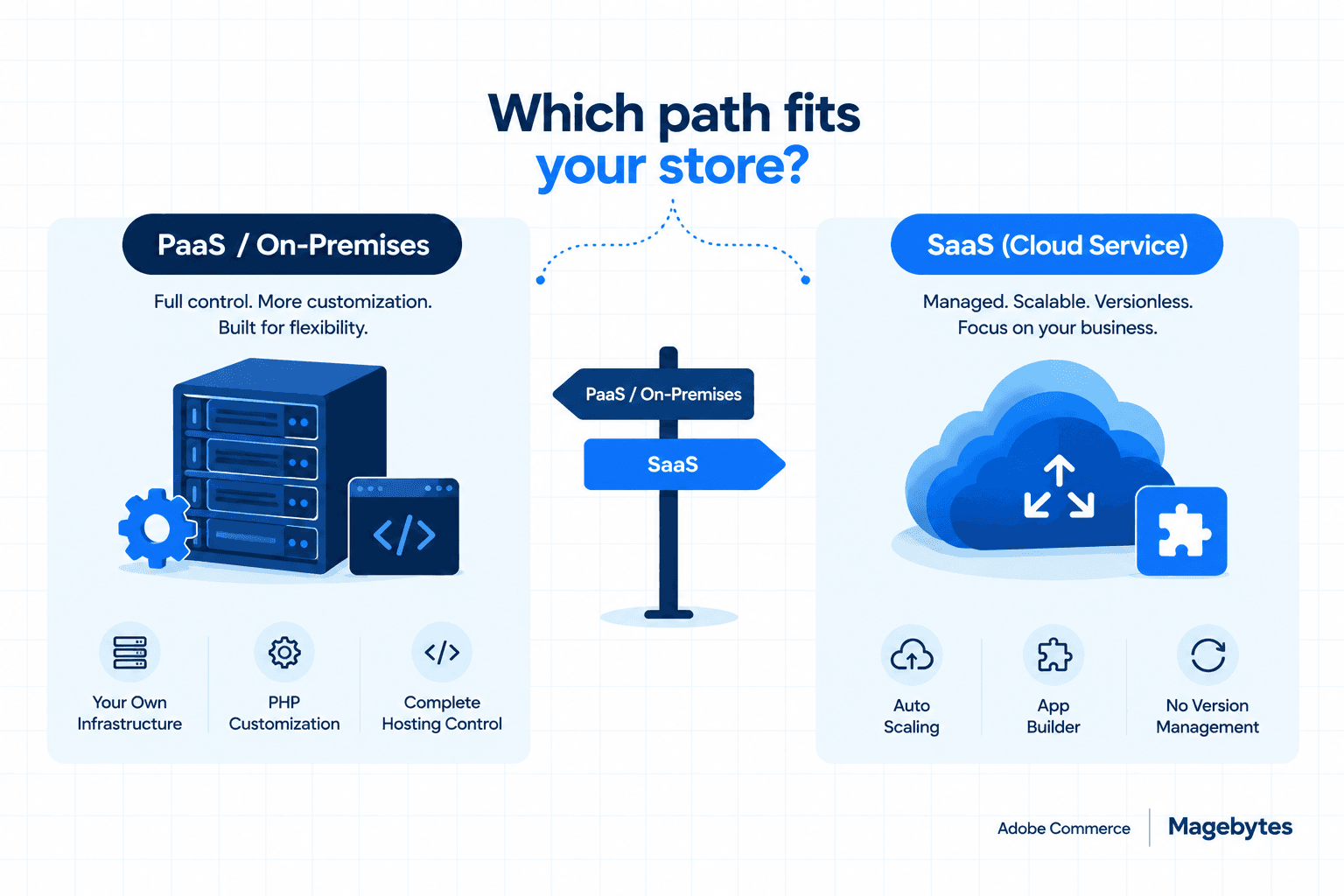
Magento / Adobe Commerce For complex catalogues, multi-site operations, and deep customisation requirements
Magento is the platform of choice when the store’s requirements are genuinely complex: large catalogues with hundreds of thousands of SKUs, multi-site deployments serving different markets from a single backend, B2B wholesale operations with account-level pricing and purchase approval workflows, or integrations so specific that off-the-shelf extensions cannot cover them. The platform was built for this level of complexity. As a Magento Development Company that has run Magento implementations from 50,000 SKU catalogues to multi-region enterprise deployments, the depth of the platform’s configuration and extensibility is real. Nothing else in this comparison comes close on enterprise-grade catalogue management.
Adobe Commerce, the commercial tier of Magento, adds B2B features natively (company accounts, requisition lists, custom catalogues per account), a more sophisticated promotions engine, and cloud infrastructure managed by Adobe. If your budget allows it and your requirements lean B2B, it is worth evaluating. On the development side, working with certified Adobe Commerce Development specialists rather than generalist Magento developers becomes important at this scale because the platform’s feature set at the enterprise tier requires specific knowledge to configure correctly.
The honest trade-offs: Magento is expensive to build and expensive to maintain. A properly implemented Magento store costs more than an equivalent Shopify build. The technical overhead is higher. The developer pool is smaller than it was five years ago. For a store with a straightforward product range and a team without dedicated technical resource, Magento is probably the wrong choice regardless of budget.
When it is right: manufacturer selling to trade accounts, large retailers with complex catalogue logic, businesses needing heavy ERP integration baked into the commerce layer, or any organisation where you can hire Magento developers to own the platform long term.
Shopify / Shopify Plus For speed to market, ease of management, and the best app ecosystem in ecommerce
Shopify is the most successful ecommerce platform in the world right now by merchant count, and there are good reasons for that. The admin experience is genuinely easier than any of the alternatives. The app ecosystem covers the majority of functionality most stores will ever need. Shopify handles hosting, security patching, and platform upgrades so the merchant’s team does not have to. As a Shopify Development Company that works on both Shopify and Shopify Plus, the speed-to-value advantage is real. A well-scoped Shopify build can be live and trading in six to ten weeks. A comparable Magento build would be four to six months minimum.
Shopify Plus, the enterprise tier, adds multi-site management through Shopify Markets, B2B features (custom storefronts per account, net payment terms), automation through Shopify Flow, and dedicated support. For direct-to-consumer brands scaling toward enterprise, Plus is worth serious evaluation against Adobe Commerce because the total cost of ownership is considerably lower and the operational maintenance burden is much smaller.
The custom Shopify store design work we do at MageBytes ranges from initial builds for growth-stage brands to headless Shopify Plus storefronts using the Storefront API and a Next.js frontend. The flexibility has expanded significantly in recent years. Where Shopify used to hit a ceiling for genuinely complex requirements, Shopify Plus in headless configuration is now competitive with Magento for many enterprise use cases.
Where it is less suited: stores with deeply custom checkout logic, complex tax requirements across many jurisdictions, manufacturer pricing structures with dozens of account-specific tiers, or any scenario where the Shopify app ecosystem’s solution is close but not quite right and the workaround would involve extensive custom development anyway.
BigCommerce For B2B-first operations and multi-channel selling without Shopify’s transaction fees
BigCommerce sits in the gap between Shopify’s ease and Magento’s complexity. The platform has stronger native B2B capabilities than standard Shopify, including customer-group-based pricing, purchase order payment terms, and configurable product rules, without requiring the same level of custom development that Magento B2B demands. For businesses that are fundamentally B2B operations but not at the scale where Adobe Commerce is justified, BigCommerce is genuinely underrated. As a provider of BigCommerce Development Services, we see this most clearly in industrial suppliers, B2B distributors, and wholesale brands that need account-level functionality without a six-figure Magento implementation budget.
BigCommerce also does not charge transaction fees for third-party payment gateways, which matters commercially for stores with high average order values using non-native payment providers. Shopify’s transaction fee structure can become significant at scale.
The honest limitation: BigCommerce’s app ecosystem is smaller than Shopify’s. For stores that are heavily reliant on specific third-party tools, the connector availability gap is real. It is improving, but worth checking for your specific stack before committing.
WooCommerce For content-first brands, small to mid-sized catalogues, and teams already on WordPress
WooCommerce makes the most sense when the business is already deeply invested in WordPress and the store is an extension of the content operation rather than the primary business system. A media brand adding merchandise, a consultant adding a course or digital product store, a small retailer where the WordPress blog drives most of the traffic. In those scenarios, running WooCommerce Development Services on an existing WordPress site avoids rebuilding a whole platform relationship from scratch.
WooCommerce is also the most cost-effective starting point for genuinely small operations. The core plugin is free. The hosting can start at a few dollars per month. The plugin ecosystem is vast. For a founder in early validation stage who needs a functioning store without significant upfront investment, WooCommerce is a reasonable answer.
Where it falls apart: medium to large catalogues where the WordPress-MySQL database combination under WooCommerce starts to strain under real traffic, complex inventory scenarios, multi-site operations, or any business where the store is expected to be the primary revenue system rather than an adjunct to content. WooCommerce stores that grow past a certain point typically face a migration decision, usually toward Shopify or Magento, and that migration costs more than building on the right platform in the first place would have.
The Decision Framework That Actually Helps
Rather than a feature matrix, these are the questions that settle the platform decision for most businesses we work with.
How complex is your product catalogue?
A simple catalogue with one product type, a handful of variants, and straightforward pricing maps cleanly to Shopify or WooCommerce. A catalogue with configurable products across multiple variants, bundle pricing, custom options at product level, and different prices for different customer segments maps to Magento or BigCommerce. The catalogue complexity question eliminates more options than any feature comparison.
Are you primarily B2B, B2C, or both?
B2C dominant with a growth focus: Shopify or Shopify Plus. B2B dominant with account-based requirements: Adobe Commerce or BigCommerce. Mixed, with B2B as the core and B2C as a secondary channel: BigCommerce or Adobe Commerce depending on scale. Pure B2C with complex catalogue logic: Magento Open Source.
What is your realistic timeline to launch?
Six to ten weeks: Shopify. Three to four months: BigCommerce or WooCommerce with custom development. Four to eight months: Magento depending on complexity. If the timeline is constrained by market conditions, investor milestones, or seasonal windows, that constraint changes the platform choice regardless of what the feature comparison says.
Who is going to own this platform after launch?
This is the question most platform selection processes underweight. Magento requires ongoing technical ownership. An in-house developer or an ongoing agency relationship is not optional; it is how the platform stays current and functional. Shopify requires far less technical ownership. If the team does not include someone who can manage a PHP-based ecommerce platform or the budget for a development partner who can, Magento is the wrong choice regardless of its capability. This is where the decision to hire Magento developers or engage a long-term development partner becomes a prerequisite, not an optional service.
The honest summary: if you are in doubt between Shopify and Magento, and your catalogue complexity does not specifically require Magento, start with Shopify. The operational overhead of the wrong platform choice compounds every month. Migrations are expensive. Starting on the right platform is cheaper than switching later.
Part Two: The Frontend Performance Decision
Once the platform is chosen, the frontend question comes up almost immediately. And for Magento stores specifically, this conversation has changed significantly over the past three years.
Hyvä Theme: What It Is and Why It Matters
Magento’s default Luma theme carries a significant JavaScript payload that directly impacts Core Web Vitals. For stores where organic search is a meaningful traffic channel, the performance gap between Luma and a properly built Hyvä Theme Development implementation is commercially significant. Hyvä is a complete frontend framework for Magento built on Alpine.js and Tailwind CSS, replacing the legacy RequireJS and KnockoutJS stack that Luma runs on.
The performance improvement is real and measurable. MageBytes clients who have migrated from Luma to Hyvä consistently report a 40 to 60 percent improvement in Largest Contentful Paint and a meaningful drop in Total Blocking Time. On stores where conversion rate correlates with performance, the migration pays for itself relatively quickly.
Hyvä is not a visual theme in the way that a Shopify theme is. It is a frontend architecture. Custom design still needs to be built on top of it, and the development complexity is meaningful. But for any Magento store that is serious about frontend performance and ranks organic search as a primary acquisition channel, Hyvä is now close to a default recommendation.
Mobile App: When It Belongs in the Stack
A common question from growing ecommerce brands is when a native or hybrid mobile app is worth building alongside the web store. The honest answer is: later than most brands think. A mobile app development company building a React Native or Flutter app for an ecommerce brand needs a clear reason why the mobile web experience cannot serve the same purpose. For most stores at early to mid-scale, a well-optimised Progressive Web App or a fast mobile-responsive storefront delivers the same conversion outcome without the ongoing app maintenance cost.
The scenarios where a native app genuinely earns its place: stores with very high repeat purchase rates where app-based push notifications drive retention, loyalty programmes where native app features (biometric login, wallet integration, camera-based scanning for QR rewards) add real value, or B2B buyers who place frequent repeat orders and benefit from a streamlined native ordering experience. Outside those scenarios, the app is more expensive to build and maintain than the benefit justifies.
Part Three: When to Bring In Managed DevOps, CRM, and ERP Support
This is the conversation most ecommerce platform guides never get to, and it is the one where growing businesses are most likely to make expensive mistakes.
The platform going live is not the end of the infrastructure journey. It is the beginning. The businesses that run ecommerce operations without a managed DevOps layer and without connected business systems are the ones that create problems that look like platform problems but are actually infrastructure and data problems.
DevOps Services for Ecommerce
A Magento or Shopify store running without proper DevOps services for ecommerce is a store waiting for a bad peak traffic event. The specific failure pattern is consistent: the store runs fine at normal volume. A sale event, a feature in press, or a paid media campaign drives a sudden traffic spike. The server queue fills. Response times climb past the point where users wait. Orders fail. The business loses revenue it spent money to acquire.
Managed DevOps for ecommerce covers the infrastructure layer that prevents this. Auto-scaling configuration so the server fleet expands under load without manual intervention. CI/CD pipelines that let the development team deploy code changes safely without taking the site down during a maintenance window. Monitoring that alerts the team to performance degradation before customers report it. Disaster recovery configurations with tested runbooks rather than improvised responses.
For Magento specifically, the DevOps configuration also covers Varnish cache, Redis for session and full-page cache, Elasticsearch cluster sizing, and the queue workers that process orders and index updates asynchronously. These are not optional extras for a store processing more than a few hundred orders per day. They are the difference between a store that scales and a store that breaks.
- When to bring in DevOps support: when the store is processing 100 or more orders per day, when you are running regular sale events or promotional spikes, when deployments require manual server access, or when the response to an outage is checking logs rather than reading from a monitoring dashboard
CRM and ERP Development Services
A store without a properly connected CRM is running customer relationships from memory and spreadsheets. A store without a connected ERP is reconciling inventory, orders, and financials manually at month end. Both situations are manageable when the business is small. Neither is manageable when order volume grows. The CRM and ERP development services conversation typically starts when one of three things happens: a warehouse team discovers a systematic inventory discrepancy, a finance team spends three days on month-end reconciliation, or a customer service team cannot see a complete order history without opening three separate systems.
The CRM integration connects your ecommerce store to your customer relationship platform. Every order a customer places becomes part of their CRM record. Support teams see purchase history without leaving the CRM. Marketing teams segment based on actual purchase behaviour. Sales teams can see which B2B accounts are growing and which are at churn risk. Salesforce, HubSpot, Zoho, and Dynamics 365 are the platforms we most commonly connect to Magento, Shopify, and BigCommerce stores, and the integration project typically takes four to eight weeks depending on the data mapping complexity.
The ERP integration closes the gap between the store and the financial and inventory system. Orders that are placed on the store appear automatically in the ERP without manual import. Inventory changes in the ERP propagate to the store in near real time, eliminating the oversell risk that comes from a nightly batch sync on a high-traffic day. Fulfilment updates flow from the warehouse management system back to the store to trigger shipping notifications. This integration layer is what allows a business to grow its order volume without growing its operations headcount at the same rate.
- When to bring in CRM integration: when customer service teams are looking up orders in two separate systems, when marketing cannot segment by purchase history, or when B2B account management is running on spreadsheets
- When to bring in ERP integration: when month-end reconciliation takes more than two days, when inventory discrepancies appear between the store and the warehouse, or when the operations team is manually entering orders into the ERP from the store admin
One pattern we see regularly: businesses that delay the CRM and ERP integration until the pain becomes acute end up spending more on the integration project because the systems have diverged over time and the data cleaning work is significant. Building the integration earlier, when data volumes are smaller and the systems are still relatively clean, is consistently cheaper.
What This Looks Like in Practice
A business that makes good decisions in this space typically arrives at something like the following sequence. They choose the platform that fits their catalogue complexity, their team’s capacity, and their launch timeline. They invest in a proper build rather than a cheap one, because the cost of rebuilding is always higher than the cost of building correctly. They start DevOps managed services when the store goes live at any meaningful scale. They connect CRM within the first six months when customer data starts to matter. They connect ERP when manual reconciliation becomes a genuine operational cost.
The businesses that struggle usually reversed that order. They built fast and cheap. They grew without addressing the infrastructure layer. They tried to add integrations after the store had been running for two years with inconsistent data across multiple systems. Each step costs more than it would have the first time.
MageBytes works with businesses at every stage of this journey. Platform selection and initial build. Performance and DevOps work on existing stores. CRM and ERP integration for operations teams that have outgrown their manual processes. Mobile app development for brands where the case is genuinely justified. If you are in the middle of a platform decision or you are hitting the infrastructure ceiling on an existing store, the conversation starts here.
Not Sure Which Platform or Services Fit Your Business? MageBytes helps growing ecommerce businesses choose the right platform, build it correctly, and connect the systems that make it scale. Twelve years. 30 countries. No generic answers. Start a conversation with our team.