Magento vs. Shopify Plus in 2027
A message lands in our inbox about once a fortnight, and it’s nearly always the same. Online revenue is somewhere in the eight figures, the current platform is creaking, and the question is simple: Magento or Shopify Plus?
We build on both, so we’ve got no horse in this race. And the short answer is that it depends. If someone gives you a firm answer in the first five minutes, they’re probably selling one of the two.
Here’s the longer answer, from a team that works as both a Magento development company and a Shopify development company.
What You’re Actually Choosing Between
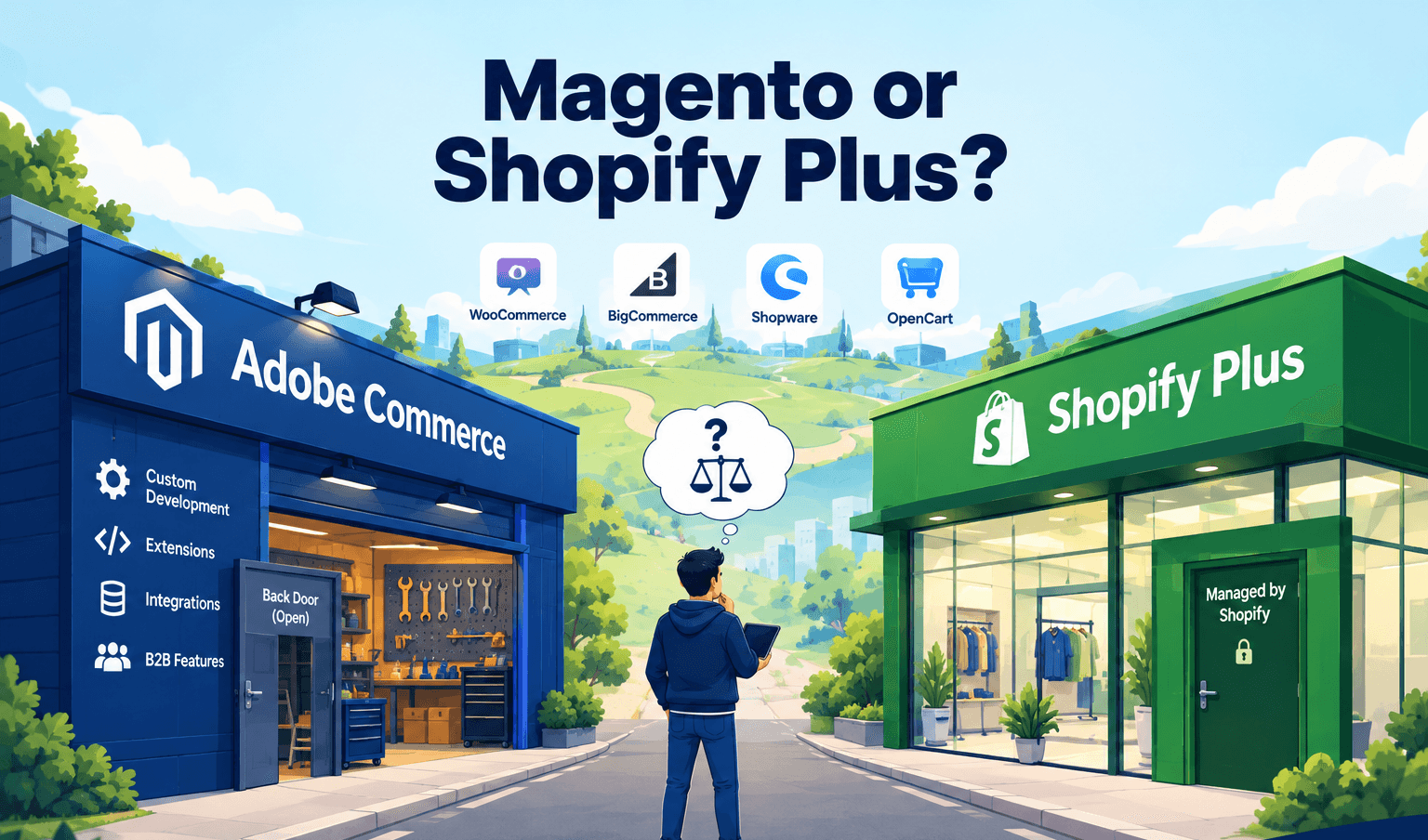
Magento is open source, and Adobe Commerce is the paid version of it. You get the whole PHP codebase. Want to rewrite part of checkout? Add a pricing engine nobody else has? Go ahead. The flip side is that the servers, the patches and the upgrades are yours to deal with, or your agency’s. Adobe also sells a hosted version called Adobe Commerce as a Cloud Service, but most big stores we see are still on the cloud-hosted or on-premises setups for now. If you’re weighing those, we wrote a separate piece on Adobe Commerce SaaS vs PaaS.
Shopify Plus is the opposite deal. Shopify runs everything. No servers, no patching, no 2 a.m. calls because the checkout is slow. In return you work inside what Shopify lets you touch: apps, its APIs, Shopify Functions for checkout rules, and Hydrogen if you want a headless front end. There’s no core code to open up, full stop.
On price, Plus has started at around $2,300 a month on a three year term, and that covers hosting. Adobe Commerce licences cost a lot more and depend on your revenue, with hosting and development on top. Both sets of numbers change, so get fresh quotes before you build a budget around anything you read here.
The Money Question
Comparing licence fees is a bit of a trap. The Shopify number includes hosting and the Adobe number doesn’t. Once you add proper cloud hosting, a developer or agency on retainer, and the extensions you’ll end up needing, a mid-complexity Adobe Commerce store usually costs more over three years than the same store on Shopify Plus.
That flips in some cases. Shopify bills creep up as you stack apps, and if you need custom apps because nothing on the store does the job, that adds up fast. A heavily customised Magento build can come out cheaper in the long run, as long as that custom logic is stable and you’re not rebuilding it every year.
Time matters too. Plus launches tend to take a few months. Magento projects often take about twice that, sometimes more. If you’ve got a deadline tied to a season or a funding round, that gap counts.
How Far Can You Bend It?
This is the part of the comparison that doesn’t move much, year to year. With Magento you can change almost anything. Shopify Plus lets you change a lot, but only in the places Shopify has opened up.
When a requirement sits outside those places, you’ve got three options on Shopify: a clunky workaround, an app that gets you eighty percent of the way, or no. We’ve seen real projects that only work on Magento. A checkout that runs a live auction. A price that depends on the customer, the date and the order quantity all at once. A multi-step approval chain built into order creation. If that sounds like your business, talk to experienced Adobe Commerce developers before you talk to anyone else.
If it doesn’t sound like your business, and for most D2C brands it doesn’t, you probably don’t need the extra freedom, and you’ll pay for it every month in maintenance.
B2B Is Where It Gets Interesting
Adobe Commerce still has the deepest native B2B toolkit out there. Company accounts with sub-users and permissions, shared catalogues, purchase order approvals, requisition lists, negotiated quotes. It’s all there without much stitching together.
Shopify has been closing the gap fast. For a business that mainly needs account-level pricing, custom catalogues and payment terms, Plus now handles it fine. Where it struggles is the heavier stuff. Think manufacturers with layered approval chains, procurement system integrations and contract pricing across hundreds of accounts.
A quick test: do your buyers need approvals before an order goes through, or does pricing need to plug into their procurement software? If yes, lean Adobe Commerce. If they just want their own prices and a tidier ordering experience, Shopify Plus will do the job.
Traffic Spikes and Who Gets the 2 a.m. Call
On Shopify Plus, a Black Friday surge is Shopify’s problem. You’ll hardly notice it. That’s a big part of what you’re paying for.
Magento on a managed cloud can absolutely handle enterprise traffic, but only if it’s set up well. We’ve audited stores that had never been load tested, had caching half configured, and carried ten years of extensions nobody had reviewed. Those stores wobble when traffic jumps. It’s fixable, but it means performance work never really ends, and somebody has to own it.
The other side of that coin is control. If you’ve got data residency rules or need to pick exactly where things run, Magento gives you that and a multi-tenant SaaS platform doesn’t.
SEO and Page Speed
Magento gives you more technical SEO control. URL structures, canonicals, hreflang, structured data, page-level robots rules, all of it can be shaped the way you want. And with the Hyvä theme in place, Magento’s front end is quick enough to hold its own against good Shopify stores on Core Web Vitals. Before Hyvä that was a tougher argument to make.
Shopify’s SEO basics are solid out of the box and need very little setup. It only gets awkward at the edges, mainly around URL paths, where Shopify has fixed conventions you work around rather than change.
Multiple Stores and Regions
Run six regional storefronts off one catalogue and one admin, with different languages, currencies and rules per region, and Adobe Commerce handles it natively. It’s one of the things it’s best at.
Shopify Plus covers the common version of this well through Markets. It gets harder when regions need very different pricing logic, product ranges or checkout flows. Then you’re either paying for separate stores or building custom work to bridge them.
It Isn’t Always These Two
A few other platforms deserve a look before you commit. BigCommerce often suits brands that have outgrown standard Shopify but don’t need Adobe Commerce, with solid built-in B2B. A Shopware development agency can be a smart pick for European brands who want Magento-style flexibility without the licence bill. WooCommerce makes sense when content drives the business and the shop supports it, though we see plenty of fast-growing WooCommerce stores outgrow it. And OpenCart is a fine starting point for smaller operations, just not really in this weight class.
How We’d Decide
Skip the feature matrix. Ask yourself these instead:
- Does checkout need to do something Shopify Functions can’t? If yes, that settles it. Magento.
- Do you have developers, or a partner, on hand for the long haul? Magento needs ongoing care. Shopify mostly doesn’t.
- How fast do you need to launch? Shopify Plus usually wins on speed.
- Are your B2B needs about pricing, or about process? Pricing, Shopify copes. Process, think Adobe Commerce.
- Do you sell through several regions with very different rules? That leans Adobe Commerce.
- Is your revenue still climbing toward the high end? If so, Adobe Commerce’s cost can be hard to justify early on.
If you’re already running Adobe Commerce and it works, we’d think hard before moving. Switching costs are real, and a migration only pays off if the day-to-day savings are bigger than the project.
What We’d Tell a Friend
A fashion brand with a tidy catalogue, standard checkout, a small tech team and a habit of moving quickly? Shopify Plus, almost every time.
A manufacturer with tens of thousands of SKUs, three regional stores with different prices, and buyers who need approvals and procurement integrations? Adobe Commerce, even though it’ll cost more and take longer. The platform does things out of the box that you’d otherwise have to build.
The brands that end up unhappy usually fall into two camps. Some picked Magento for a need Shopify could have met, and now pay for complexity they never use. Others picked Shopify for a need that really called for Magento, and spent years on workarounds.
If you’re stuck in the middle of this decision, we’ll tell you what we’d do in your position, even if the answer isn’t something we’d build. Get in touch with us here.
Magento or Shopify Plus? Let’s Look at Your Store. Tell us what your store needs to do and we’ll give you a straight recommendation, no sales pitch. Book a free platform consultation.