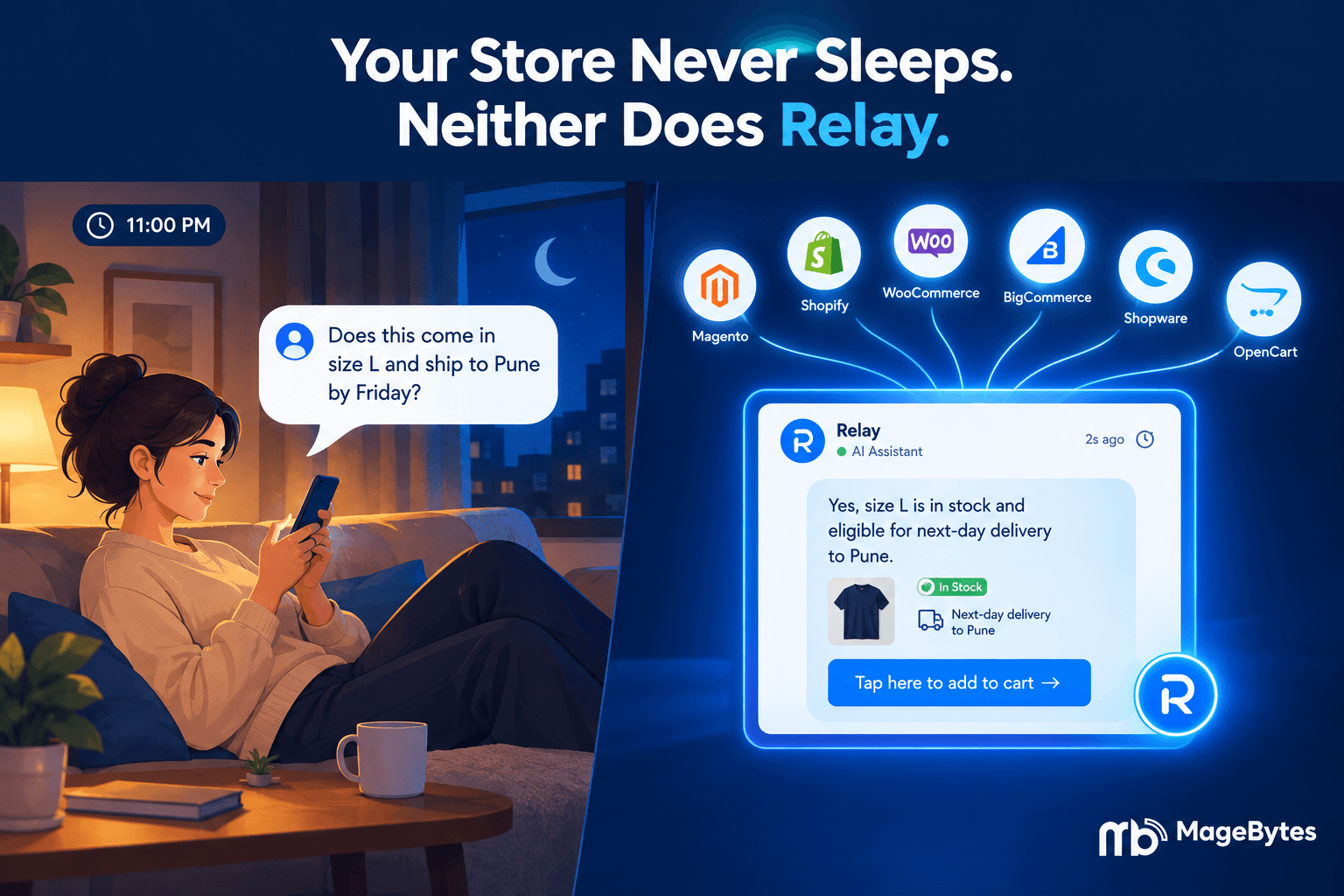
A customer lands on your store at 11:43 on a Tuesday night. They want to know whether the jacket they are looking at is available in their size, whether it ships to their city by the weekend, and whether the discount code they found on Instagram still works.
Your team is offline. The live chat shows a message about business hours. The customer waits thirty seconds, sees nothing happening, and closes the tab.
That sale did not fail because of your product. It failed because nobody was there.
Relay by MageBytes was built specifically for this problem. It is an AI shopping assistant that connects to your ecommerce store and handles customer conversations around the clock, without your team needing to be present for every query. Order status, product availability, shipping timelines, discount eligibility, return policies. Relay answers what it knows, escalates what it does not, and keeps the conversation moving regardless of what time zone or what hour the customer is shopping from. You can start a free 14-day trial without a credit card and have it deployed to your store in under five minutes.
This blog covers what Relay actually does, which platforms it connects to and how, the security architecture behind it, and the kind of businesses that get the most out of it.
The Problem with Ecommerce Customer Support as It Currently Works
Most online stores handle customer support in one of two ways. Either a small team manages live chat and email during business hours and everything outside those hours goes into a queue that the customer waits on, or the store uses a basic chatbot that recognises a handful of keywords and routes everything else to a human anyway.
Neither works well at the moments that matter most. Weekday evenings and weekends are often when consumer purchases happen, especially for anything that requires a bit of research before buying. That research naturally generates questions. And if those questions go unanswered for hours, the conversion does not just get delayed; it frequently does not happen at all.
The AI chatbot category has been around long enough that most ecommerce store owners have tried at least one. The consistent complaint is the same: it answers the easy questions well and falls apart on anything specific. What is the stock level on this specific variant? Does the promotion apply to this category? Will this order arrive before the event I need it for? These are not unusual questions. They are the questions that determine whether a hesitant shopper becomes a paying customer.
Relay is not a keyword-matching bot. It connects to your store’s live product data, your order management system, and your configured policies, and it generates answers from that context rather than from a fixed script. The difference in response quality for specific product and order queries is meaningful, and it shows up directly in the conversations your customers have.
What Relay Actually Does
Handles the conversations your team gets most
Order tracking is the most frequent customer support query in ecommerce, consistently. A customer who placed an order two days ago and has not received a shipping notification will message support before they will check their email again. Relay handles this query directly: it reads the order status from your connected store and gives the customer an accurate, current answer without a support ticket being raised.
Product availability, variant stock levels, expected restock dates, compatible accessories, size guidance, material specifications. Any query that can be answered from the product data in your store is handled by Relay without escalation. This covers the majority of pre-purchase questions that customers ask and that, if unanswered quickly, contribute to cart abandonment.
Shipping timelines, delivery estimates by location, current promotions, discount code validity, return window and process. Relay is configured with your store’s policies and applies them accurately when these questions come up. A customer asking whether they can return something they ordered eight days ago gets the correct answer based on your actual return policy, not a generic holding response.
Escalates what it should not guess at
An AI agent that tries to answer everything is worse than one with defined limits. Relay is built to recognise the queries where a confident automated answer is not appropriate: complex complaints, refund negotiations, situations where the customer is clearly frustrated and needs a human, queries about specific order disputes where the context requires someone with authority to act.
When Relay identifies these situations, it escalates the conversation to your support team with a full context summary. The team member who picks it up does not have to ask the customer to repeat themselves. The conversation history, the order details Relay retrieved, and the reason for escalation are all in the handoff. This is the feature that makes the difference between an AI agent that saves your team time and one that just creates a different kind of work. Set up your Relay workspace in five minutes and configure your escalation rules before your team even needs to be involved.
Tracks performance so you can see what it is doing
Live usage analytics are built into Relay’s dashboard. Conversation volume by day, resolution rate versus escalation rate, the specific queries that come up most often, conversion rate attribution for conversations where Relay was the last touchpoint before purchase. This data is not just reporting. It tells you what your customers are confused about, what product information gaps are generating the most questions, and where your policies are unclear enough that customers need to ask.
Over time, the most practically useful thing the Relay analytics surface is the query categories that keep generating escalations. Those are the specific areas where either the product data needs to be clearer, the policies need to be more explicit, or Relay’s configuration needs to be updated to handle a class of questions it was not initially set up to address.
Which Platforms Relay Connects To
Relay is built as a platform-agnostic layer that connects to your ecommerce backend through its native API rather than requiring platform-specific custom development. The integration reads product data, order information, and configured policies from your store and uses that as the context for every customer conversation.
Adobe Commerce / Magento Deep catalogue support, B2B-ready, configurable product handling
For stores running on Adobe Commerce or Magento Open Source, Relay connects through the Magento GraphQL and REST API layer. This gives it access to the full product catalogue including configurable products with all their variants and attribute combinations, which is where a lot of simpler chatbots fail. A customer asking whether a configurable product is available in a specific combination of size and colour gets an accurate answer because Relay is reading the actual child product stock from the Magento inventory layer, not summarising a parent product description.
For Adobe Commerce B2B deployments, Relay respects customer group pricing and company account configurations. A B2B buyer logged into their trade account gets responses based on their account-specific catalogue, not the retail pricing shown to guest visitors. This is a meaningful capability for wholesale stores where the product visibility and pricing model differs significantly by customer type.
Shopify and Shopify Plus Fastest setup, native Storefront API, multi-currency and multi-language support
The Shopify integration is the quickest to deploy. Relay connects through Shopify’s Storefront API and Admin API, giving it access to product data, variant availability, order status, and metafield-stored custom data within minutes of the connection being configured. For Shopify Plus stores running multiple markets with multi-currency pricing, Relay applies the correct currency and regional policy for the customer’s session automatically.
Shopify’s webhook infrastructure also means Relay receives real-time updates when inventory changes, orders are fulfilled, or product data is modified. The AI agent is always working from current data rather than a cached snapshot that might be hours old during a busy sale period.
WooCommerce WordPress-native, flexible product types, REST API connected
For WooCommerce stores on WordPress, Relay connects through the WooCommerce REST API. Product data, order information, variation availability, and configured shipping zones are all accessible to Relay through this connection. The integration handles the variable product structure that WooCommerce uses for products with options, so a customer asking about a specific product variant gets an accurate stock answer rather than a summary of the parent product.
WooCommerce stores that use custom post types or custom product data beyond the standard WooCommerce fields can expose that data to Relay through the API’s custom field access, which means stores with specific industry requirements or unusual data structures are not limited to the default product fields.
BigCommerce B2B features, channel-aware, customer group pricing
The BigCommerce integration uses BigCommerce’s V3 API and Storefront API to pull product catalogue data, pricing rules, customer group configurations, and order information into Relay’s context. For BigCommerce B2B stores where customer-group-specific pricing and catalogue visibility are key, Relay applies the correct context based on the logged-in customer’s group assignment.
BigCommerce’s multi-channel selling setup, where the same catalogue is sold across multiple storefronts or marketplaces, is handled by Relay’s channel-aware configuration. Each channel can be configured with its own policy set and escalation rules within the same Relay workspace.
Shopware Headless-ready, API-first architecture, modern stack compatible
Shopware’s API-first architecture makes it a natural fit for Relay’s integration model. Shopware stores running either the traditional Shopware frontend or a headless setup using Shopware’s Store API connect to Relay through the Store API’s product, category, and order endpoints. The headless Shopware pattern, increasingly common for brands that want complete frontend control while retaining Shopware’s commerce backend capabilities, works cleanly with Relay because the integration sits at the API layer rather than the frontend layer.
Shopware’s Shopping Experiences and content management features are also accessible to Relay for stores that have embedded editorial content alongside product data, allowing the AI agent to answer questions that combine product information with editorial guidance from the store’s content pages.
OpenCart Lightweight, extension-based, REST API integration
For OpenCart stores running the REST API extension, Relay connects through the product and order endpoints to access catalogue data and order status. OpenCart’s lightweight architecture means the integration is relatively straightforward to configure, and the API access covers the core product and order data that most customer queries require.
OpenCart stores that have been customised with additional modules can expose that custom data through OpenCart’s API extension system. The configuration step requires mapping the custom data fields to the Relay context model, but this is handled during the initial setup rather than requiring ongoing custom development.
Security Architecture
Relay handles customer conversation data and reads order information from connected stores. The security architecture reflects that responsibility.
AES-256 Encryption
All data at rest in Relay is encrypted using AES-256, which is the same encryption standard used in banking and healthcare infrastructure. This covers conversation logs, customer query data, API credentials for connected stores, and the configuration data that defines how Relay behaves in each workspace.
JWT Token Rotation
Relay uses JSON Web Tokens for authentication between the AI agent layer and connected store APIs, with automatic token rotation built into the authentication flow. Tokens are short-lived and rotated on a defined schedule, which limits the window of exposure if a token were ever compromised. This is the authentication pattern recommended for production API integrations rather than static API keys.
Role-Based Access Controls
Within a Relay workspace, access controls are configured by role. A support team member can view conversation logs and manage escalations. A store administrator can configure the AI agent settings, update policy content, and manage the platform connection. The roles are separate and independently configurable, which means a team member who needs to handle escalations does not require the same access level as the person who configured the integration.
SOC 2 Ready, GDPR Safe, 256-bit Encrypted
Relay is SOC 2 ready and built with GDPR compliance as a design requirement, not a retrofit. Customer data from conversations is handled in accordance with data minimisation principles: Relay uses the information it needs to answer the query and does not retain raw conversation content beyond the period required for analytics and audit purposes. For ecommerce businesses serving EU customers, this compliance posture removes a significant evaluation hurdle that comes up with many third-party chat tools.
Who Gets the Most Out of Relay
Stores with a small support team and growing order volume
The most immediate ROI from Relay is in stores where the support team is being stretched by volume. When two or three people are handling customer queries across live chat, email, and social, and the majority of those queries are the same fifteen questions about orders, shipping, and availability, Relay takes that repetitive load off the team entirely. The team handles the conversations that actually need human judgment. Relay handles everything else.
Stores selling internationally across time zones
A store in India selling to customers in the UK, UAE, Australia, and Singapore has a support window problem. Business hours in Noida do not overlap meaningfully with the evening shopping hours in any of those markets. Relay removes the time zone problem. The AI agent is available in every market at every hour, configured with the shipping policies and delivery timelines relevant to each region.
Stores with complex or configurable product catalogues
The deeper the product catalogue, the higher the volume of pre-purchase queries about specific variants, compatibility, or specifications. This is particularly true for Magento and Adobe Commerce stores with large configurable product ranges where customers frequently need to confirm a specific combination is available before committing to a purchase. Relay’s direct API connection to the catalogue means these queries get accurate, real-time answers rather than generic product descriptions that leave the customer still uncertain.
Brands focused on conversion rate improvement
Cart abandonment that results from unanswered questions is one of the few conversion problems with a direct mechanical fix. If a customer is hesitating because they have a question, and the question gets answered before they leave the page, the hesitation is removed. Relay’s ability to handle these in-session queries, particularly during evenings and weekends when your team is offline, directly addresses one of the most common sources of pre-checkout abandonment.
Setup: Five Minutes to a Live AI Agent
The claim that Relay deploys in under five minutes is a specific and honest one. The setup sequence is: create a workspace on relay.magebytes.com/signup, connect your store by entering your platform API credentials, configure your store policies (return window, shipping timelines, escalation triggers) through the guided setup, and embed the Relay chat widget on your storefront using the provided code snippet or the platform-specific plugin. The 14-day trial starts immediately, no credit card required, and the AI agent is live from the moment the widget is embedded.
The policy configuration step is the one that takes the most time, not because it is technically complex but because it requires having your policies written clearly. Return policy, exchange policy, shipping cut-off times, discount eligibility criteria, what Relay should escalate versus handle. If those policies exist in a document somewhere, the setup is genuinely fast. If they have never been written down formally, that is actually a useful exercise beyond the Relay setup itself.
Relay is currently live on Shopify and Magento as of launch. BigCommerce, WooCommerce, Shopware, and OpenCart integrations are in active development and rolling out through late 2026. If your store is on one of these platforms, signing up now places you in the early access queue for your integration and locks in the founding member pricing that will not be available at general availability.
The Straightforward Case for Trying It
A fourteen-day free trial with no credit card is the lowest-commitment way to evaluate whether an AI agent makes a difference on your specific store with your specific customers. The setup is fast enough that the trial starts from a live deployment, not from a demo environment, so the data you get over those fourteen days is real customer conversation data from your actual store.
Customer support availability is one of those operational problems that gets easier to ignore at smaller scales and harder to ignore as order volume grows. The queries do not change much. The volume does. At a certain point, handling them manually costs more in staff time than automating them costs in tooling, and that crossover point arrives sooner than most teams expect.
Relay sits at an unusual intersection: it was built by MageBytes, a team that has spent twelve years building and integrating ecommerce platforms for merchants across 30 countries. The AI agent is not a generic chat tool repackaged for ecommerce. It was designed specifically for the catalogue complexity, the order query patterns, and the integration requirements of the platforms it supports. That context shows up in the quality of the answers it gives, which is ultimately the only thing that matters when your customer is deciding whether to complete a purchase at 11 PM. Start the trial here.
Your Store, Always On. Relay by MageBytes handles customer conversations 24/7 across Adobe Commerce, Shopify, WooCommerce, BigCommerce, Shopware, and OpenCart. Free 14-day trial. No credit card. Deploy your AI agent in five minutes.